How to Build a Crypto Scalping Playbook
TL;DR. A scalping playbook is a written set of trade cards, one per setup, each with conditions that can be checked before the order, a trigger, an entry, a stop, targets, exit rules, no-trade filters and a running record of results in R. It exists because a setup that lives in your head changes every time you are under pressure, and because the only way to know whether a setup works is to count. Start with one card, trade it fifty times at minimum size, and let the numbers decide whether it earns a second. The trap is judging a setup on twenty trades: at that sample the measured win rate is uncertain by twenty percentage points either way, which is the difference between a good strategy and a losing one.
Prerequisites for this lesson: Trading expectancy (win rate, average win, average loss, expectancy in R), Position sizing and risk management (1R and the notional), Trade exit strategy (the exit rules a card has to name). Every setup in this track can be written as a card; the stop-hunt reversal is used as the example.
What a playbook is
Mike Bellafiore, who runs a proprietary trading desk and wrote The PlayBook, defines it as the archive of the trades that make the most sense to you: the setups you understand well enough to explain, trade well enough to repeat, and have the records to prove. His desk's traders build from those and drop everything else. The idea transfers to a crypto scalper without change. The market offers a hundred things to do every hour; the playbook is the short list of the ones you have evidence for.
A playbook is not a strategy guide, a set of indicators or a list of rules copied from a course. It is your own trades, written down before they are taken and counted after. Two properties make it work:
- Every condition is checkable. "Strong support" is not a condition. "At least three touches of the level in the last four hours, each reversed" is. If a condition cannot be answered yes or no by looking at the chart, it cannot be tested and it will drift.
- Every trade is recorded against the card. Which conditions were met, where the entry, stop and exit were, the result in R, the fees, and whether the rules were followed. Without the record the card is a wish.
The card
One card per setup. Here is the stop-hunt reversal from lesson 10 written as a card; the numbers are the ones from that lesson.
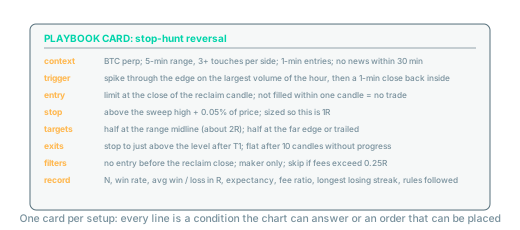
| Field | What goes there | Stop-hunt reversal example |
|---|---|---|
| Context | instrument, timeframes, regime, session | BTC perp; 5-minute range with 3+ touches per side; 1-minute entries; no scheduled news within 30 minutes |
| Setup conditions | checkable facts that must be true | obvious level (range edge, prior high/low, round number); spike through it on the largest volume of the hour |
| Trigger | the single event that makes the trade live | a 1-minute candle closes back inside the level |
| Entry | order type and price | limit at the close of the reclaim candle; if not filled within one candle, no trade |
| Stop | level and size in R | above the sweep high plus 0.05% of price; position sized so this is 1R |
| Targets | the ladder | half at the range midline (about 2R); half at the far edge, or trailed behind 5-minute swing highs |
| Exit rules | what else ends the trade | stop moved to just above the level after target 1; flat after ten candles without progress |
| No-trade filters | when the setup is skipped | before the reclaim closes; with taker fills; when fees exceed 0.25R; in the 30 minutes before a scheduled release |
| Size | R per trade and the maximum open risk | 1R = 1% of the account; one position at a time |
| Record | the running statistics | N, win rate, average win and loss in R, expectancy, fee ratio, longest losing streak, rule-following rate |
Tape readers have long described setups as if-then scenarios: if price does this, then I do that; if it does the other, then I do nothing. The card is the scenario written in full. Every line on it is an "if" that the chart can answer or a "then" that a stop order can execute.
Why one card first
The temptation is to write five cards in an evening. Do not. Each card needs fifty trades before its record means anything, and a trader who is learning five setups at once collects ten trades on each and knows nothing about any of them. Worse, the five setups compete for attention: while you are watching for a sweep you miss the pullback, and while you are in the pullback the range breaks. One setup, traded until its numbers are stable, then a second. Bellafiore's desk calls this building from strengths; the arithmetic below is why it is not optional.
Choose the first card by fit, not by expected profit. A trader who can sit through a forty-minute narrow range without clicking should start with the stop-hunt reversal. A trader who cannot should start with the trend pullback, where the waiting is shorter and the failure is cleaner. The best setup is the one whose rules you will follow.
The statistics that decide
The card's record has five numbers that matter, and one of them is the one traders skip.
Expectancy, gross. Win rate times average win, minus loss rate times average loss, in R. A card with a 58% win rate, an average win of 1.4R and an average loss of 1.0R has a gross expectancy of 0.58 × 1.4 − 0.42 × 1.0 = +0.39R per trade. On a $10,000 account risking 1R = $100, that is $39 per trade before costs.
Expectancy, net of fees. The number traders skip. Fees are charged on the notional, and with a tight stop the notional is large. On the range-fade sizing from lesson 6, a $55,300 position pays $22 in maker fees per round trip, 0.22R, and $55 in taker fees, 0.55R. The same card:
| Gross expectancy | Fees per trade | Net expectancy | Per 100 trades | |
|---|---|---|---|---|
| Maker fills | +0.39R | 0.22R | +0.17R | +$1,720 |
| Taker fills | +0.39R | 0.55R | −0.16R | −$1,600 |
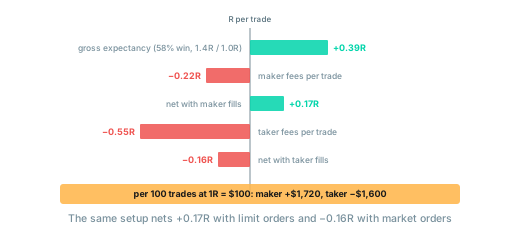
The same setup, executed with market orders instead of limit orders, goes from earning $1,720 per hundred trades to losing $1,600. Nothing about the chart changed. This is the number that explains why a trader can "follow the strategy exactly" and lose, and it is why every card carries a fee ratio and a filter on it. The trade execution lesson covers how to get maker fills.
Sample size. A win rate measured on a small sample is a guess with error bars. For a true win rate near 58%, the range that the measurement lands in 95% of the time is roughly:
| Trades recorded | Measured win rate could be anywhere in |
|---|---|
| 20 | 58% ± 22 points (36% to 80%) |
| 50 | ± 14 points (44% to 72%) |
| 100 | ± 10 points (48% to 68%) |
| 300 | ± 6 points (52% to 64%) |
At twenty trades you cannot tell a 58% setup from a 40% one, and a 40% win rate with these R multiples loses money. Fifty trades is the minimum before a card is judged; a hundred before it is traded at full size. The advice given to system traders applies to a discretionary card as well: know the profile of results you expect, including the losing streaks, before you trade it, so that a normal bad week does not look like a broken setup, and a broken setup does not look like a normal bad week.
Losing streaks and drawdown. With a 58% win rate, a run of five consecutive losses has better than even odds of appearing somewhere in any 100 trades, and the typical worst drawdown over those 100 trades is about 5R, with one run in ten reaching 8R or more. These are the numbers for a setup that works. A trader who quits a card after four losses, or doubles size after four wins, is reacting to noise that the card's own statistics predicted. Write the expected streak on the card so that it is expected.
Rule-following rate. The fraction of trades on the card that were taken exactly as written: right trigger, right entry, right stop, right exit. This is the one number that is entirely in your control, and in the first months it explains more of the P&L than the setup does. A card with a positive expectancy and a 60% rule-following rate is not being traded; a different, unwritten setup is, and its expectancy is unknown.
The review
Once a week, per card, with the records open:
- Net expectancy after fees over the last 30 trades, compared with the card's full history. A rolling number that falls below zero for two consecutive reviews means the setup or its execution has changed; it does not yet say which.
- Rule-following rate. Below 90%, the review is about discipline, not about the setup. Find the rule that gets broken and the situation that breaks it, and add a filter.
- The losing trades, one by one. Was each one a correct trade that lost (the card working as designed) or a rule broken? Only the second kind is a mistake.
- The biggest loss. If it is larger than 1.2R, something moved the stop or the size. That is the most expensive habit a scalper has and the review exists to catch it early; the risk of ruin lesson shows what a few oversized losses do to a small account.
- The fee ratio. Fees divided by gross profit. Above 50%, the setup is working for the exchange.
- Screenshots of the two best and two worst trades, annotated with the conditions. Over months these become the pattern library that Bellafiore's traders build, and they are what makes the next card faster to write.
Changing a card is allowed at the review and nowhere else. A rule changed during a trade is not a rule.
The traps
- Backfilling the card. Writing the conditions after the trade, to match the trade. The card then describes what you did, not what you will do, and the record measures nothing.
- Counting hypothetical trades. "I would have taken that one." The record contains trades with a fill and an exit, and nothing else.
- Judging on twenty trades. The error bars above. Twenty trades is an anecdote.
- Adding a card because the first one is boring. The first card is boring because it works: most of its trades are small and its rules keep you out of the exciting ones. Boredom is the cost of the record; the second card is earned by fifty trades, not by restlessness.
- Tuning the card to the last loss. After each loss, a new filter that would have avoided it. After ten losses, ten filters, and the setup never triggers. Filters are added at the review, on a pattern across trades, not on one.
- Treating the playbook as finished. Markets change; a card that worked in a high-volatility regime may not in a quiet one. The rolling 30-trade expectancy is the alarm, and a card that has failed it for a month is retired, not defended.
Checklist for a new card
- Can every setup condition be answered yes or no from the chart?
- Is the trigger a single, closed event?
- Are the stop and the size written so that the stop is exactly 1R?
- Are the targets and every other exit rule named, including the time stop?
- Is the fee bill per trade on the card in R, and is there a filter on it?
- Is the expected losing streak on the card?
- What is the minimum sample before this card is judged, and is it at least fifty?
Where to go from here
This is the last lesson of the strategies track. You have the setups, the timing tools, the exit rules and the document that turns them into a system. The next step is not another setup; it is fifty recorded trades of one card.
- Crypto scalping strategies: the track from the beginning, to choose the first card.
Related guides:
- Trading expectancy: the arithmetic of win rate and R in depth.
- Risk of ruin: what oversized losses do to a small account.
- Win rate vs risk/reward: why a 58% win rate needs 1.4R wins after fees.
- Trade execution: maker fills, the difference between +$1,720 and −$1,600.
- Common scalping mistakes: the habits the rule-following rate is there to catch.
- Glossary: expectancy, win rate, drawdown, risk/reward ratio.
This article is educational content, not investment advice. Trading derivatives carries substantial risk, including total loss of capital. See disclaimer.