Best Crypto Exchange for Scalping: Fees, Liquidity & Execution
TL;DR. The best crypto exchange for scalping is the one where a round trip costs least after fees, spread and slippage, whose book is deep enough that your size does not move it, and whose matching engine stays up when the market is fast. On those criteria a small number of large perpetual-futures venues (Binance, Bybit, OKX, Hyperliquid, and Deribit for options) cover most retail scalpers; the exact winner depends on your size, your jurisdiction and whether you need options. The one thing that is not a matter of taste: a scalper cannot work on a venue that trades against its clients, and this lesson explains how to recognise one.
Prerequisites for this lesson: Crypto order types (maker, taker, post-only, reduce-only), Trade execution (fees, spread and slippage as one cost). Lesson 6 of the getting started section.
What a scalper needs from a venue
A swing trader pays the venue's costs once a week and notices them once a year. A scalper pays them fifty times a day, and the choice of venue is the single largest fixed cost in the business. Everything below follows from that.
1. Fees: the schedule and the tier
Perpetual venues charge by side: a maker fee for limit orders that rest in the book and a taker fee for orders that take liquidity. At the entry tier on the major venues, maker fees run from zero to 0.02% and taker fees from 0.045% to 0.055%; volume tiers, native-token discounts and referral schemes lower both. The exchanges comparison keeps the current schedules; the point here is what the numbers do.
| Venue type, entry tier | Maker | Taker | Round trip, both legs maker | Round trip, both legs taker |
|---|---|---|---|---|
| Large perpetual exchange | 0.02% | 0.05% | 0.04% | 0.10% |
| Options venue, perpetual contract | 0.00% | 0.05% | 0.00% | 0.10% |
| CFD broker, "commission-free" | spread 0.05% to 0.15% each way | 0.10% to 0.30% | 0.10% to 0.30% |
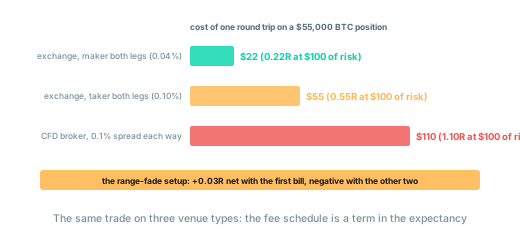
On a $55,000 position, the size the range fade lesson arrives at for $100 of risk with a 0.18% stop, 0.04% is $22 per trade and 0.10% is $55. Over 100 trades that is $2,200 against $5,500, and the lesson shows the same setup earning with the first bill and losing with the second. The fee schedule is not a footnote; it is a term in the expectancy of every trade you will take.
Two details matter more than the headline rate. The tier: a schedule that reads 0.02% at entry level and 0.012% at a volume you will never reach is a 0.02% schedule. And the base for the rebate: some venues pay a rebate only to makers above a volume threshold, and a "negative maker fee" in marketing usually applies to someone else's account.
2. Liquidity: depth, spread and what your size does to it
A fee schedule you can read; liquidity you have to measure. Three questions:
- How wide is the spread on the contract you will trade, at the hours you will trade? On BTC and ETH perpetuals at the large venues it is one tick most of the day. On the same coins at a small venue, or on a mid-cap coin anywhere, it can be five to twenty ticks, which is a fee that never appears on any schedule.
- How much rests at the first five levels? If your order is 0.5 BTC and the book shows 3 BTC at the best ask, a market order fills cleanly; if it shows 0.2 BTC, your order walks the book and the order book lesson explains what that costs.
- What happens to the book in a fast minute? Depth on a quiet afternoon says nothing. Watch the book during a US data release: the venues with real market makers thin out and refill; the venues without them empty and stay empty.
Liquidity is also the reason the choice narrows to a few names. Depth attracts depth: the venue with the most flow gets the tightest quotes, which attracts more flow. A venue advertising a lower taker fee with a wider spread and a thinner book costs more per round trip than a venue with a higher fee and a tight, deep market.
3. Reliability under stress
Every venue works on a calm day. The test is the fast minute: a cascade, a headline, a large expiry. The failure modes are known, and each has cost real traders real money:
- The interface freezes while the engine keeps matching. Your stop is in the book and fires; your screen shows a stale price for ninety seconds. Survivable if the stop was in the book, ruinous if it was in your head.
- Order rejections and "system busy". New orders are refused for the duration of the spike. A position that needed an exit does not get one.
- Auto-deleveraging. When the venue's insurance fund cannot cover a liquidation, the winning positions on the other side are closed by the exchange to balance the book. A profitable trade ends at a price you did not choose. The large venues publish ADL indicators and rarely trigger them on majors; small venues trigger them more often.
Public status pages and post-mortems exist for the large venues; read the last two years of them before depositing. A venue with no incident history published is not a venue without incidents.
4. Order types and margin controls
A scalper's execution depends on features that not every venue offers, or offers on every contract:
- Post-only limit orders, so that a maker fill is guaranteed or the order is cancelled.
- Reduce-only flags on stops and targets.
- Stop-market orders that trigger on the mark price rather than the last trade, so that a single stray print cannot fire them.
- Isolated margin per position, and clear maintenance-margin tiers.
- A funding schedule you can plan around: fixed eight-hour settlements or continuous accrual, both fine, both worth knowing; the funding lesson has the detail.
- API access with the same fee schedule as the interface, for the day you want a tool to place the orders; the API vs interface lesson covers when that day comes.
5. The venue that trades against you
Every criterion above assumes that when you send an order, it goes to a shared order book where other participants take the other side. That is how an exchange works. It is not how a B-book broker works, and the difference is the most important thing in this lesson.
A B-book broker, the "kitchen" in trader slang, does not route your order to a market. It takes the other side itself. Your long is the broker's short, your loss is the broker's profit, and the "order book" on your screen is a display the broker controls. The typical package is a CFD on Bitcoin, no commission, a spread that widens when the market is fast, and marketing aimed at beginners. The consequences for a scalper:
- The spread is the fee, and it moves. A 0.1% spread each way is a 0.2% round trip, twice the taker cost at an exchange, and it widens exactly when you need to exit.
- The broker sees your stop. It does not need to hunt it; it only needs to set its own quote through it during a spike, and your stop fills at a price that printed nowhere else.
- Order flow reading is impossible. There is no tape, because there is no market; the trades on the screen are between you and the house. Every lesson in the strategies track that reads absorption or aggression is meaningless there.
- Slippage is discretionary. On an exchange, slippage is what the book does to your order. On a B-book venue it is what the broker decides your order is worth.
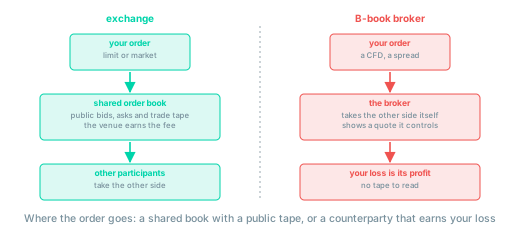
How to tell the two apart: an exchange publishes a live order book and a trade feed that third-party tools can read, lists its fees as maker and taker, settles funding between clients, and shows you the trades that happened. A B-book venue offers CFDs or "synthetic" contracts, quotes a spread instead of a fee, has no public tape, and often advertises leverage as the product. Some brokers run both models; for a scalper the distinction is not academic, and the exchanges section reviews only venues with a public book.
6. Jurisdiction, custody and the boring parts
- KYC and availability. The large centralised venues require identity verification and restrict some countries. Using a VPN to get around a restriction puts your funds at the venue's discretion when it notices.
- Custody. A centralised exchange holds your collateral. Keep on the venue what you are trading with and withdraw the rest; exchange failures are a feature of the industry's history, not an exception. Decentralised perpetual venues such as Hyperliquid let you trade from your own wallet, with the operational responsibilities that come with self-custody.
- Withdrawals. Test one before you need one.
Testing a venue before committing
The way to choose is not to read reviews. It is to open an account, deposit a small amount and run the same test on each candidate for a week:
- Trade your setup at minimum size with post-only limits and record how often they fill.
- Place ten small market orders at different hours and compare the fill with the quote you saw: that is your slippage.
- Watch the book during one scheduled release.
- Add up the fees the venue actually charged against the fees the schedule promised.
- Withdraw the balance.
A venue that passes is one you can build a playbook on. A venue that fails the test at minimum size will fail it at full size with more money on the line.
Checklist
- Maker and taker fees at the tier you will actually reach, in R per trade at your typical position?
- Spread and depth on your contract at your hours, measured, not assumed?
- Incident history read; stops in the book, not on the screen?
- Post-only, reduce-only, mark-price stop-market and isolated margin available?
- A public order book and a public tape (an exchange), not a spread on a synthetic contract (a B-book)?
- Can you verify, deposit and withdraw legally from where you are?
Where to go from here
You have the criteria and the test. The next lesson lists the mistakes that end most beginner accounts, several of which are venue mistakes in disguise.
- 10 crypto scalping mistakes: overleveraging, averaging down, revenge trading and the rest, with the arithmetic of each.
Related guides:
- Crypto exchanges compared: the venues side by side, with current schedules.
- Deribit: the reference venue for crypto options.
- Trade execution: fees, spread and slippage as one monthly number.
- Order book and DOM: what a public book shows and what it cannot.
- Position sizing and risk management: why the fee bill is measured in R.
- Crypto scalping for beginners: the section hub.
- Glossary: maker/taker fee structure, CEX, DEX, slippage.
This article is educational content, not investment advice. Trading derivatives carries substantial risk, including total loss of capital. See disclaimer.