Crypto Funding Rates Explained: Meaning, Formula & Signals
TL;DR. A funding rate is a periodic payment between the longs and the shorts in a perpetual futures contract, and it is the mechanism that keeps a contract with no expiry anchored to the spot price. Positive funding means longs pay shorts, which happens when the perpetual trades above spot and the market is leaning long; negative funding means shorts pay longs. For a scalper, crypto funding rates are context rather than a trigger: they say how crowded one side is and how expensive it is to stay there, and crowded sides get squeezed. The limitation is timing. Funding can stay extreme for days in a strong trend, and a trader who fades it on its own is early by definition.
Prerequisites for this lesson: Perpetual futures (what a perpetual is and why it needs an anchor), Trends (the feedback loop that funding measures from the outside). Lesson 5 of the market mechanics section.
Why perpetuals need funding
A dated future converges to spot at expiry because at expiry it settles at spot. A perpetual never expires, so nothing forces its price back to the underlying, and without a corrective mechanism it could drift for as long as one side kept leaning on it. Funding is that mechanism.
Think of it as rent. If you hold a long overnight in a market where everyone else is long, you pay rent to the shorts for occupying that side. The more one-sided the market, the higher the rent, and the rent nudges some longs to close, which pulls the perpetual back towards spot. Nobody at the exchange sets the direction of the payment; the premium of the perpetual over spot sets it.
How it works in practice
Binance, Bybit and OKX settle funding at fixed times, every eight hours at 00:00, 08:00 and 16:00 UTC on most contracts (some pairs settle every four hours, and the schedule can change; check the contract page). Deribit quotes an eight-hour rate but pays it continuously, accruing into realised P&L second by second rather than at a settlement. Hyperliquid pays hourly. The differences matter when you compare rates across venues, which is why they are all quoted per eight hours.
At each settlement on the fixed-time venues:
- Positive funding: longs pay shorts, in proportion to position size.
- Negative funding: shorts pay longs.
- No position at the settlement timestamp: nothing paid or received.
Example: funding +0.01%, position $10,000. You pay $10,000 × 0.01% = $1.00 at settlement. That is trivial. At +0.1%, a level seen for stretches of every bull run, it is $10 every eight hours, $30 a day, and more than 100% of the position annualised. Holding a leveraged long through sustained high funding is a cost that has to be earned back by the move before anything is profit.
How it is calculated
The formula differs in detail by venue, but the logic is the same everywhere:
- Measure the premium. The percentage by which the perpetual trades above or below the spot index over the funding window, usually as a time-weighted average.
- Add the interest component. A small fixed baseline, typically 0.01% per eight hours, that stands for the cost of borrowing one currency against the other. It is usually negligible.
- Clamp the result. Exchanges cap the rate per window so that a dislocated market cannot produce a ruinous payment. The caps differ by contract and change over time: on Binance the BTCUSDT cap is ±0.3% per eight hours at the time of writing, and a contract that hits its cap switches to hourly settlement until the premium normalises. Check the contract specifications on the venue you trade.
Perpetual above spot: positive funding, longs pay, shorting the perpetual and buying spot earns the funding, which pushes the perpetual down. Perpetual below spot: negative funding, the reverse. The arbitrage that closes the gap is the reason the anchor holds.
What funding signals
Funding is one of the more honest sentiment measures available, because it is paid in money by people with positions rather than answered in a survey.
| Funding, per 8 hours | What it suggests |
|---|---|
| 0.00% to 0.01% | Neutral. Neither side is crowded; the interest baseline dominates |
| +0.03% to +0.07% | Elevated bullish positioning. Longs are in charge but not yet paying much for it |
| +0.10% and above | Crowded long side, expensive to hold. The probability of a squeeze the other way rises |
| −0.01% to −0.05% | Bearish positioning. Shorts are in charge |
| −0.10% and below | Crowded short side or acute fear. Short-squeeze conditions |
These are thresholds to be aware of, not entry signals. High funding does not mean price must reverse; it can stay elevated for hours or days in a strong trend, with the longs paying and still winning. What it does mean is that the trade is becoming more expensive for the crowded side, that the crowded side has liquidation prices stacked in the same place, and that those positions will eventually be unwound, either by choice or by the liquidation engine.
How scalpers use funding
As a directional filter. With funding at +0.15% or higher, a new long is a bet against the crowd and against the cost of carry. Many scalpers reduce or avoid long bias in those conditions and look for shorts or range setups instead. The bias is a lean, not a rule.
As reversal context. Funding that spikes to an extreme and then starts to fade often marks a crowd being squeezed out. Read with price and open interest, it tells you whether a move is new positioning or old positions being forced to close.
As a timing tool. The fixed settlement times create small patterns around them: some traders close before a settlement when funding is high, some target the volatility that occasionally surrounds it. For a two-minute scalp the settlement itself is rarely a factor.
Funding and open interest together
Funding tells you which way the crowd is leaning. Open interest tells you whether positions are being opened or closed. Read together, they say whether a move has new money behind it or is running on positions leaving.
| Price | OI | What is happening | Sustainability |
|---|---|---|---|
| Rising | Rising | New positions on both sides, buyers aggressive: new demand is being financed by new shorts | Higher |
| Rising | Falling | Positions closing on both sides: shorts covering, longs taking profit; a squeeze, not new demand | Lower |
| Falling | Rising | New positions, sellers aggressive: new supply financed by new longs | Higher |
| Falling | Falling | Positions closing: longs liquidated or capitulating, shorts covering into them | Often short-lived |
With funding added: rising price, rising OI and neutral funding is the strongest combination, new money entering without a crowded side. Rising price, falling OI and high positive funding is the weakest: shorts being forced out, the long side already crowded and paying for it.
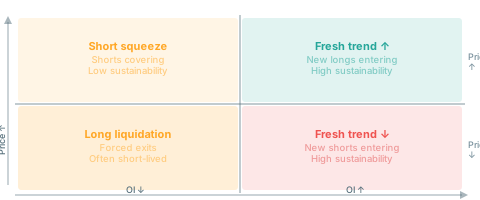
This is a tool for reading the quality of a move, not for timing entries. The open interest lesson adds the caveat that OI counts both sides of every contract, so the direction in the table comes from price and the tape, not from OI alone.
Funding across venues
Funding differs by exchange. Binance, Bybit, OKX and Deribit can show materially different rates for the same coin at the same moment, because their trader bases and their positioning differ. Binance at +0.08% with Deribit at +0.01% says the retail-heavy venue is more crowded long than the venue used by options desks and hedgers. The divergence is information; which venue's funding predicts price best is something you learn from records rather than from a rule, and watching several is always more informative than watching one.
Common misconceptions
- "High funding means a crash is coming." It raises the probability of a correction and says nothing about when. Trends have run for a week on extreme funding.
- "Short it because funding is high." Not without a setup. Funding is context for a trade chosen on structure, and the stop hunt and reversal lessons show what a setup looks like.
- "Funding does not matter for scalping." The settlement rarely hits a two-minute trade, but funding still tells you which side of the market is crowded, and crowded sides are where the sweeps and cascades happen.
- "Negative funding means a rally is due." It raises the probability, particularly at extremes. Sustained negative funding is also normal in a long bear market.
Where to go from here
Funding is the price of a crowded side. The next lesson is the other half of the positioning picture: how many positions are open, and whether they are being opened or closed.
- Open interest: what a change in OI counts and how to read it with price and the tape.
Related guides:
- Perpetual futures: how the instrument that pays funding works.
- Liquidations: what happens when the crowded side is unwound by force.
- Trends: the feedback loop that pushes funding to extremes.
- Position sizing and risk management: why a position that pays funding needs a wider margin of safety.
- Crypto market mechanics: the section hub.
- Glossary: funding rate, open interest, perpetual futures.
This article is educational content, not investment advice. Trading derivatives carries substantial risk, including total loss of capital. See disclaimer.