Crypto Options Explained for Beginners: Calls, Puts & Premium
TL;DR. An option is a contract that gives the buyer the right, and not the obligation, to buy or sell an asset at a fixed price before a fixed date, in exchange for a payment made up front called the premium. Crypto options explained in one sentence: a bought option turns an open-ended loss into a fixed one and keeps the gain open, and the premium is the price of that asymmetry. The limitation is that the premium is priced by professionals from the market's own estimate of the coming move, so a buyer has to be right about the direction, the size and the timing of the move at once, and most beginners are right about only the first.
Prerequisites for this lesson: Crypto options trading (where options sit among the instruments), Position sizing and risk management (the R unit used in every example). Lesson 1 of the options track.
Why options exist
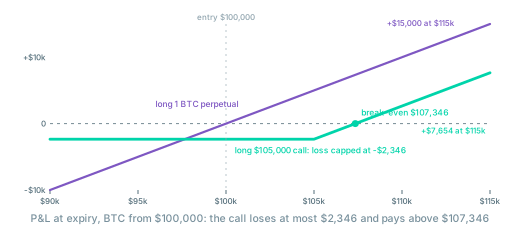
Spot, futures and perpetuals are linear. A long position on 1 BTC from $100,000 makes $1,000 for every $1,000 the price rises and loses $1,000 for every $1,000 it falls, without limit in either direction until a stop or the liquidation engine intervenes. The leverage lesson shows what that symmetry does to a small account: one sharp move against the position ends the trade whatever the trader's view was worth.
Options were built to break the symmetry. The buyer pays a known amount today and in return owns a claim that cannot cost more than that amount, no matter what the market does. Insurance works the same way at the level of the payoff: a fixed premium, a claim that pays only if the bad thing happens, and no regret when it does not. The pricing logic is different (an insurer prices from claims statistics, an options market prices from the cost of hedging the contract in the underlying market), but the shape of the deal is the same, and the shape is what a beginner needs first.
The two contracts
Every options position is built from two contracts.
A call is the right to buy the asset at the strike price before expiry. A buyer of a call wants the price above the strike by expiry, and the further above the better.
A put is the right to sell the asset at the strike price before expiry. A buyer of a put wants the price below the strike, and also owns a put when they hold the asset and want a floor under it.
Each contract has a buyer and a seller. The buyer pays the premium and holds the right. The seller receives the premium and takes on the obligation: to deliver the asset at the strike if a call is exercised, or to buy it at the strike if a put is. That gives four basic positions:
| Position | Wants | Maximum loss | Maximum gain |
|---|---|---|---|
| Buy a call | Price up | The premium | Open-ended |
| Buy a put | Price down | The premium | The strike, if price went to zero |
| Sell a call | Price flat or down | Open-ended | The premium |
| Sell a put | Price flat or up | The strike, less the premium | The premium |
Buying has a small, fixed loss and a large possible gain; selling has a small, fixed gain and a large possible loss. Beginners start as buyers, because a buyer's worst day is known in advance. What selling involves is the subject of lesson 8.
A call, priced properly
The numbers in this track are computed with the standard pricing model at an implied volatility of 55%, an ordinary reading for Bitcoin, so that they resemble what the screen shows. BTC trades at $100,000. A trader expects a rise over the next two weeks and buys a 14-day call with a $105,000 strike. The premium is about $2,346.
At expiry the call is worth its intrinsic value, the amount by which BTC is above the strike, or nothing:
| BTC at expiry | Call is worth | Net result | What happened |
|---|---|---|---|
| $115,000 | $10,000 | +$7,654 | Large move, the payoff outran the premium |
| $110,000 | $5,000 | +$2,654 | Moderate move, a modest profit |
| $107,000 | $2,000 | −$346 | Right direction, but not by enough |
| $105,000 | $0 | −$2,346 | Price sat on the strike; the whole premium is gone |
| $100,000 | $0 | −$2,346 | No move; same loss |
| $90,000 | $0 | −$2,346 | A 10% crash; the loss is still the premium |
Two rows deserve a second look. At $107,000 the trader called the direction correctly, price rose 7%, and the trade still lost, because the call needs BTC above $107,346 at expiry to break even: the strike plus the premium. At $90,000 a perpetual long of 1 BTC would have lost $10,000; the call lost $2,346. Those two rows are the whole trade-off. A capped loss costs a hurdle, and the hurdle is the premium.
A put, priced the same way
Same market, opposite view. The trader buys a 14-day put with a $95,000 strike for about $2,153.
| BTC at expiry | Put is worth | Net result |
|---|---|---|
| $85,000 | $10,000 | +$7,847 |
| $90,000 | $5,000 | +$2,847 |
| $95,000 or higher | $0 | −$2,153 |
The put pays below $92,847 and loses the premium anywhere above the strike. Buying a put against BTC that the trader already owns is the most common use of the contract, and lesson 7 prices it.
What the premium is made of
Premium = intrinsic value + extrinsic value.
Intrinsic value is what the option would be worth if exercised this second: for a call, the price minus the strike when that is positive; for a put, the strike minus the price. A $95,000 call with BTC at $100,000 has $5,000 of intrinsic value. A $105,000 call has none.
Extrinsic value is everything else in the price: the market's payment for the possibility that the option finishes further in the money than it is now. It is larger when more time remains, when the market expects bigger moves (the implied volatility of lesson 3), and when the strike is near the current price, where the outcome is most uncertain.
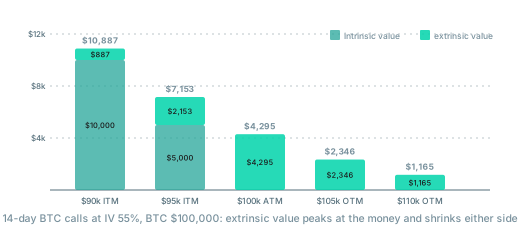
The figure shows the same 14-day calls across five strikes. The $90,000 call costs $10,887, of which $10,000 is intrinsic and only $887 is the price of possibility. The $100,000 call costs $4,295, all of it extrinsic. The $110,000 call costs $1,165, also all extrinsic, but far less of it, because a 10% rise in two weeks is a lot to ask.
Extrinsic value has one property that decides most beginner outcomes: it goes to zero at expiry, every time, whatever the price does. An option is worth only its intrinsic value on the last day. The daily loss of extrinsic value is called theta, and it is why "BTC went up and my call still lost money" is a normal sentence rather than a paradox: the price rose too slowly, and the time value drained faster than intrinsic value was built. Lesson 2 puts numbers on the rate.
Moneyness: where the strike sits
In the money (ITM): the option already has intrinsic value. A $90,000 call with BTC at $100,000 is $10,000 in the money. It is expensive, and most of its price is real value rather than possibility; it behaves much like the asset itself.
At the money (ATM): the strike is at the current price. No intrinsic value, the largest extrinsic value on the chain, and roughly a coin-flip chance of finishing in the money.
Out of the money (OTM): no intrinsic value. Cheap, a low probability of paying, and a large percentage return on the occasions it does, which is why the far strikes attract beginners and why most of those premiums are lost in full.
For a first trade the choice is usually between at the money and slightly out of the money. Deep out of the money is a lottery ticket priced by professionals; deep in the money is mostly a substitute for the asset with a wide spread attached.
The five things an option does that a perpetual cannot
- A loss defined before entry. The premium is the worst case, held through any gap, cascade or weekend, with no stop to be slipped and no liquidation price.
- An accelerating payoff. Above the strike each further $1,000 of move is worth more than the last as the option's delta grows; below it the loss stays flat. The perpetual's line has the same slope everywhere.
- A position on movement rather than direction. A call and a put bought together pay when the price moves far enough either way. That structure is the straddle of lesson 10.
- Time as something that can be sold. The extrinsic value that drains from a buyer flows to a seller. Selling it is a business with its own risk, covered in lesson 8, and no linear instrument offers it at all.
- A hedge with a known cost. A put under a holding limits the loss below its strike for a premium fixed in advance, while the upside stays open. A short perpetual against the same holding removes both.
What the contract on the screen means
A Deribit quote reads like BTC-25DEC26-100000-C: the underlying, the expiry date (25 December 2026), the strike ($100,000) and the type (C for call, P for put). Three details matter before the first order:
- Style and settlement. Deribit's options are European, exercised only at expiry, and cash-settled: at expiry the difference between the settlement price and the strike is paid in the settlement currency, and no coins change hands. Nothing stops a buyer selling the option back to the market at any time before expiry, which is how nearly every position is closed.
- Quotation in coin. BTC option prices are quoted in BTC, so $4,295 appears as 0.043 BTC at $100,000. The dollar equivalent is shown beside it; the coin quote is what the order ticket takes.
- Contract size. A Bitcoin option contract is 1 BTC and the minimum trade is 0.1 BTC, so the smallest at-the-money 14-day call in this lesson costs about $430, and the smallest $105,000 call about $235. On a $10,000 account with 1R = $100 that is 4.3R and 2.4R at risk in one position, which is already more than the sizing rules allow. A beginner's first options are small by necessity, not by choice.
Expiries settle at 08:00 UTC: daily contracts, weekly ones on Fridays, monthly on the last Friday of the month and quarterly on the last Friday of March, June, September and December.
Traps
- Buying direction and paying for volatility. The premium already contains the market's expected move. A trader who expects a 3% rise and buys a call priced for 8% of movement is betting against the price they just paid. Lesson 4 shows the arithmetic around a scheduled event, where this trap is at its worst.
- Cheap strikes. A $110,000 call for $1,165 needs a 10% rise in two weeks to be worth anything at expiry. The price is low because the probability is low.
- Holding to expiry by default. Extrinsic value can be sold at any time. A buyer whose view has played out early keeps the remaining time value by closing rather than waiting for it to drain.
- Sizing by the premium alone. The premium is the maximum loss, and it is also the normal loss: most bought options expire worthless. A position sized so that the premium is 20% of the account is a 20% loss that will happen routinely.
Checklist before a first purchase
- Which contract, which strike, which expiry, and what the option is worth at expiry at three prices: the strike, the break-even and the target.
- The premium in dollars and in R, and whether the account can lose it in full several times in a row.
- The break-even price and the move required to reach it, compared with the market's own expected move (lesson 3).
- A plan to close early if the move arrives, rather than holding for expiry.
- One live contract watched through its whole life before any real money: the premium against the price each day, and the drain in the final days.
Where to go from here
- Options Greeks explained: delta, gamma, theta and vega, the four rates at which the position above changes with price, time and volatility, with the same $100,000 call as the example.
Related guides:
- Crypto options trading: the instrument next to spot, futures and perpetuals.
- Implied volatility and skew: where the 55% in this lesson comes from and what it says about the expected move.
- Options vs perpetual futures: when the option is the better tool and when the perpetual is.
- Position sizing and risk management: the R unit and why a premium is sized like any other loss.
- Deribit guide: the venue, its contract specifications and fees.
- Crypto options for beginners: the track hub.
- Glossary: call option, put option, premium, strike price, expiry.
This article is educational content, not investment advice. Options trading carries substantial risk, including the loss of the entire premium. See disclaimer.