Options Greeks Explained: Delta, Gamma, Theta & Vega
TL;DR. The Greeks are the rates at which an option's price changes: delta with the price of the underlying, gamma with the speed at which delta itself changes, theta with the passing of a day, and vega with a one-point change in implied volatility. Options Greeks explained on a real contract: a 14-day $100,000 Bitcoin call at 55% volatility costs $4,295, moves $0.52 per dollar of BTC, loses $153 a day to time and gains or loses $78 per volatility point. Every platform shows these numbers; the lesson is in reading them together, because a trade can win on delta and still lose on theta and vega. The limitation is that the Greeks are model outputs that assume small moves and constant volatility, and in a crash both assumptions fail at once.
Prerequisites for this lesson: Crypto options explained (premium, strike, expiry, intrinsic and extrinsic value), What is volatility (standard deviation of returns). Lesson 2 of the options track.
Why an option has the price it has
An option is a payment for a range of outcomes. To price it, the market needs a view of how far the price could travel before expiry, and that view is expressed as a probability distribution of returns whose width is the volatility. A narrow distribution means most outcomes sit near today's price and options are cheap; a wide one means large moves are plausible and options are expensive. The buyer of a $105,000 call is paying for the part of the distribution that lies above $105,000, and the wider the distribution, the more of it there is.
Volatility is quoted as an annual figure. Converting it to the horizon of a trade is the one calculation every options trader does by hand:
- Daily one-standard-deviation move ≈ annual volatility ÷ 19.1 (the square root of 365). At 55% that is 2.9%, or about $2,880 on a $100,000 Bitcoin.
- Weekly ≈ annual ÷ 7.2. At 55%, about 7.6%.
- Two weeks ≈ annual ÷ 5.1. About 10.8%.
The model behind these numbers treats returns as normally distributed, which Bitcoin's returns are not: the tails are fatter, so moves beyond three standard deviations arrive more often than the bell curve allows. Options prices carry a correction for that in the skew of lesson 3. For everyday reading of the Greeks the normal approximation is close enough; for the size of the worst day it is not.
Two volatilities matter. Realised volatility is what the price has done, measured from past returns. Implied volatility is what the market is charging for, backed out of option prices. The whole business of options trading sits in the gap between them: options are cheap when the market will move more than implied and expensive when it will move less, and nobody knows which until afterwards.
Delta: how much the option moves with the price
Delta is the change in the option's price for a $1 change in the underlying. The 14-day $100,000 call has a delta of 0.52: BTC rises $1,000, the call gains about $520. Puts have negative delta; the matching put's delta is −0.48.
| 14-day option, IV 55% | Strike $90,000 | $95,000 | $100,000 | $105,000 | $110,000 |
|---|---|---|---|---|---|
| Call delta | 0.85 | 0.70 | 0.52 | 0.34 | 0.20 |
| Put delta | −0.15 | −0.30 | −0.48 | −0.66 | −0.80 |
Delta doubles as a rough probability that the option finishes in the money: the $110,000 call's 0.20 says roughly one chance in five of BTC closing above $110,000 in two weeks. It is not exact, and it is close enough to size a position with.
Delta is also the position's exposure in units of the underlying. A 0.52-delta call on 1 BTC behaves, for small moves, like 0.52 BTC held outright. That is the number a hedger uses: sell 0.52 BTC of perpetual against the call and the position is, for the moment, indifferent to direction. The options dealer on the other side of every trade does exactly this, continuously, and lesson 13 follows the consequences into the perpetual market.
Gamma: how fast delta changes
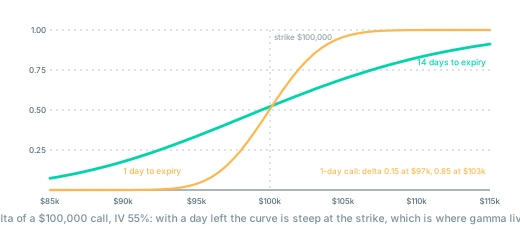
Delta is not constant. As BTC rises, the $100,000 call becomes more like the asset (delta climbs towards 1); as BTC falls it becomes less like it (delta falls towards 0). Gamma is the rate of that change per $1 of move. For the 14-day call it is about 0.037 per $1,000: BTC rises $1,000 and delta goes from 0.52 to roughly 0.56.
Gamma is what makes a bought option's payoff bend. With price moving in the buyer's favour, delta grows and each further dollar earns more; with price moving against, delta shrinks and each further dollar costs less. A seller has the mirror image: losses that accelerate and gains that slow. That is the entire reason selling options without a hedge is dangerous and buying them without a hedge is merely expensive.
Gamma concentrates at the strike and grows as expiry approaches. The figure shows the 14-day call's delta rising smoothly across $30,000 of price; the same call with one day left goes from 0.15 to 0.85 across $6,000. Near expiry an at-the-money option is a switch: on or off, decided by a move of a few thousand dollars. A trader who is short that switch has a position whose exposure can change by most of a Bitcoin in an hour.
Theta: what a day costs
Theta is the change in the option's price from one day passing with everything else unchanged. It is negative for bought options: the extrinsic value of lesson 1 drains, and theta is the daily rate.
| $100,000 call, IV 55% | 30 days | 14 days | 7 days | 3 days | 1 day |
|---|---|---|---|---|---|
| Price | $6,284 | $4,295 | $3,038 | $1,989 | $1,148 |
| Theta per day | −$105 | −$153 | −$217 | −$331 | −$574 |
| Gamma per $1,000 | 0.025 | 0.037 | 0.052 | 0.080 | 0.139 |
| Vega per point | $114 | $78 | $55 | $36 | $21 |
Theta accelerates as expiry approaches, for the at-the-money option. Halving the time to expiry does not halve the price: the 30-day call costs $6,284 and the 7-day call $3,038, because extrinsic value grows with the square root of time rather than with time itself. Thirty days to fourteen costs $1,989; the last seven days cost the whole $3,038. The last week is where a bought at-the-money option is most expensive to hold and a sold one earns fastest.
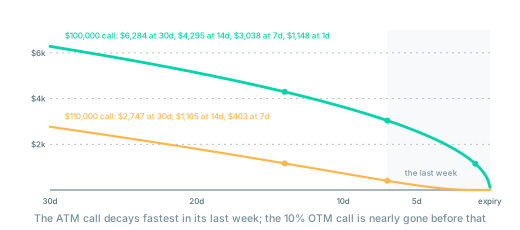
The out-of-the-money option behaves differently, and the difference is worth knowing before buying cheap strikes. The $110,000 call is worth $2,747 at 30 days, $1,165 at 14 and $403 at 7: most of its value has gone before the last week starts, because with a week left a 10% move has become improbable and the market stops paying for it. The "cliff" belongs to at-the-money options. An out-of-the-money option decays earlier and then has nothing left to lose.
Theta and gamma are the same trade-off seen from two sides. The table shows both rising together as expiry approaches: the option that responds most to a move is the option that costs most per day of waiting. A buyer pays theta to own gamma; a seller collects theta by carrying gamma risk. No position gets one without the other, and lesson 9 prices the exchange rate between them.
The practical use of theta is a hurdle. Theta multiplied by the days the trade needs is the cost of waiting, and the expected move has to cover it as well as the premium's intrinsic hurdle. A 14-day call held for a week costs about $1,250 in theta before any move is counted.
Vega: what a change in volatility costs
Vega is the change in the option's price for a one-point change in implied volatility. The 14-day call has a vega of $78: implied volatility goes from 55% to 56% and the call is worth $78 more, with BTC unmoved.
Bitcoin's implied volatility moves a long way in a short time, and vega is where that shows up in a position. Before a scheduled event, IV rises as traders pay for protection; when the event passes, it falls. A buyer of the 14-day call who sees IV drop ten points, from 55% to 45%, loses about $780 from vega alone, more than five days of theta, and a rise of the same size pays the same amount. Longer-dated and at-the-money options carry the most vega: the 30-day call at $114 per point has half as much again as the 14-day.
The most common way a correct directional view loses money is vega. The trader buys before the event, the price moves the right way, and the volatility that was paid for is taken back faster than the move pays. Lesson 4 works that case through in full.
The four together: six days in one position
Greeks are read together because they act together. A trader buys the 14-day $100,000 call at $4,295 with BTC at $100,000 and IV at 55%.
Day 1. BTC rises to $102,000. Delta contributes about +$1,040 (0.52 × $2,000), gamma adds about +$75 as delta grew during the move, theta takes −$153, IV is unchanged. The call is worth $5,256, up $961.
Days 2 to 5. BTC sits at $102,000. Nothing happens to the price, and four days of theta at a rising rate take about −$670, while IV drifts from 55% to 52% as the market calms and vega takes about −$205. The call is worth $4,385, down $871 from day 1. The position is still in profit, by $90, after a 2% move in its favour.
Day 6. BTC jumps to $105,000. Delta is now 0.61, so the $3,000 move contributes about +$1,830, gamma adds more as delta climbs through the move, theta takes one more day. The call is worth $6,259, up $1,874 on the day.
After six days the trade is up $1,964, and the path shows what a bought option is: four quiet days took back nearly everything a good first day earned, and the second move rescued it. The direction was right throughout. Without the second move the trade would have expired close to flat, and with two more quiet days it would have been a loss.
Reading the Greeks on the screen
| Greek | The question it answers | How to use it |
|---|---|---|
| Delta | How much of the asset is this position, right now? | Delta × contracts = exposure in BTC; compare with the perpetual size you would be comfortable holding |
| Gamma | How fast will that exposure change? | High near the strike and near expiry; a short gamma position needs a hedge plan, not a stop |
| Theta | What does each day of waiting cost? | Theta × days held is the hurdle the move must clear on top of the premium |
| Vega | What does a change in the market's fear cost? | Vega × plausible IV change, checked before any event; the biggest single risk for buyers |
Why a perpetual scalper reads them
- Dealers hedge delta in the perpetual market, so large options positions produce buying and selling that is mechanical rather than opinion-driven; near expiry, when gamma is highest, that flow concentrates at the strikes with the most open interest. Lesson 13 explains how to read it and how uncertain the sign is in crypto.
- A rising IV means the market is pricing larger moves. That correlates with wider perpetual spreads, more slippage and closer liquidation clusters, all of which change scalp sizing before any option is involved.
- The daily one-standard-deviation move derived from IV is a free estimate of the day's range, useful for the same purpose as ATR and available before the session opens.
Traps
- Treating delta as fixed. A 0.34-delta call is a 0.34 BTC position today and a 0.60 BTC position after a rally. Sizing that ignores gamma sizes the wrong trade.
- Ignoring theta in the plan. A view that needs two weeks to play out pays two weeks of theta. If the expected move does not cover the premium plus the theta of the holding period, the trade has negative expectancy before it starts.
- Buying vega at the top. Any option bought when IV is elevated carries a vega loss waiting to happen. Check where IV sits against its recent range before buying, and prefer selling structures or spreads when it is high.
- Reading the Greeks in isolation. The six-day example lost $871 on days when delta contributed nothing. Each Greek was small; together they were most of the position's profit.
Checklist
- Delta of the position in BTC, and whether that exposure is acceptable as a perpetual position.
- Gamma near the strike and near expiry: is the position long the switch or short it?
- Theta × planned holding days, added to the premium as the hurdle for the move.
- Vega × the plausible IV change over the holding period, especially across scheduled events.
- The daily one-standard-deviation move from the current IV, as the scale of what "a normal day" means for the position.
Where to go from here
- Crypto implied volatility and skew: where the 55% comes from, why puts and calls carry different volatilities, and what the term structure says about the next weeks.
Related guides:
- Crypto options explained: the contract and its premium, the foundation for the Greeks.
- IV crush: vega in action, on a call that loses after a correct directional call.
- Crypto volatility trading: the theta-for-gamma exchange rate, delta-hedged.
- Options risk management: the Greeks as risk sensors and the stress test that combines them.
- VIX vs DVOL: the index that publishes Bitcoin's implied volatility.
- Position sizing and risk management: the R unit that a premium and a theta bill are measured in.
- Crypto options for beginners: the track hub.
- Glossary: delta, gamma, theta, vega, implied volatility.
This article is educational content, not investment advice. Trading derivatives carries substantial risk, including total loss of capital. See disclaimer.