Bitcoin Options Max Pain Explained: Meaning & Limitations
TL;DR. Max pain is the settlement price at which the options open for a given expiry would be worth the least in total to the people who hold them: the strike where the most contracts expire worthless. Bitcoin max pain is quoted before every large Deribit expiry, and price does sometimes drift towards it in the final day or two, through a mechanism in dealer hedging rather than through anyone's intent. It is a reference level for a quiet expiry week, useful when price is already near it and worthless when it is not. The limitation is the one most cited numbers share: it describes positioning as of now, it moves as positions change, and any real flow overrides it.
Prerequisites for this lesson: Options Greeks (delta and gamma, and dealer hedging), Crypto open interest. Lesson 5 of the options track.
What the number is
Take every option open for one expiry: each strike, its calls and its puts, and the open interest at each. For any candidate settlement price, add up what all of those contracts would pay out: each call pays the settlement price minus its strike when that is positive, each put pays its strike minus the settlement price, multiplied by the open interest. Do this for every candidate price. The price at which the total payout is smallest is max pain: the settlement at which option holders, in aggregate, receive the least and option writers keep the most.
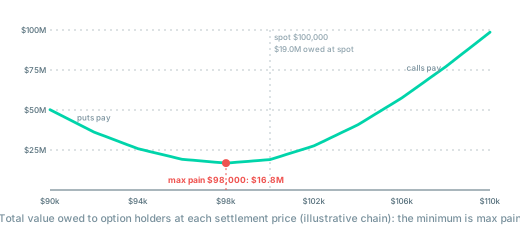
The figure uses an illustrative chain: eleven strikes from $90,000 to $110,000, puts concentrated below spot and calls above, the usual shape for Bitcoin. With BTC at $100,000 the total owed to holders would be $19.0 million at a settlement of $100,000, $16.8 million at $98,000 and $36 million at $92,000. Max pain is $98,000. Nothing in the calculation involves prices, volatility or time; it is open interest and arithmetic, which is why it is easy to compute and why several free services publish it for BTC and ETH from Deribit's public chain.
Why price sometimes drifts towards it
Max pain would be a curiosity if price ignored it, and it usually does. The reason it sometimes does not is the hedging described in lesson 2 and developed in lesson 13.
Most options are sold to the market by dealers, who hedge the delta of what they hold with the perpetual or spot. When the dealer is net long options near a strike (customers sold them premium), the position is long gamma: as price rises above the strike, its delta grows and the hedge is to sell; as price falls below, the hedge is to buy. Selling rallies and buying dips around the strike is a stabilising flow, and in the final day before expiry, when gamma at the near-the-money strikes is at its largest, that flow is at its largest too. Price gets pulled towards the strikes with the most open interest and held there, which is where max pain tends to sit.
The same mechanism reverses when the dealers are net short options at the strike: their hedging buys rallies and sells dips, and price is pushed away from the strike rather than towards it. Which case applies is not published; it has to be inferred, and in crypto the inference is weaker than in equities, because a large part of the open interest is retail on both sides rather than institutions on one. That uncertainty, covered in the gamma exposure lesson, is why max pain works sometimes and not others. Nobody is steering the price to the level; the level is where a particular hedging flow happens to lead, when that flow is the dominant one.
What it means in practice
Deribit's contracts settle at 08:00 UTC: daily and weekly (Friday) expiries, the monthly on the last Friday of the month, and the quarterly on the last Friday of March, June, September and December. The larger the open interest at an expiry, the more the hedging around it can matter, so the monthly and quarterly expiries are the ones where the level is worth checking.
- The window is the last 24 to 48 hours. Before that, the strikes' gamma is too small to move anything and positions are still changing.
- Distance decides relevance. BTC at $100,000 with max pain at $98,000 in a quiet week is a plausible drift. Max pain at $88,000 is background information; there is no mechanism that moves price 12% in a day for the benefit of option writers.
- Any real flow overrides it. A macro release, a liquidation cascade, a large spot seller: each is bigger than dealer hedging at a strike. Max pain is a low-volatility, low-news phenomenon.
- After settlement it is gone. At 08:00 UTC the expiry's open interest ceases to exist, and the next expiry has its own level, usually somewhere else.
For a perpetual scalper the use is modest and specific. On the day before a large expiry, with price within a couple of percent of max pain and nothing on the calendar, the range around that level has a mechanical reason to hold, and breakouts from it are more likely to fail than on an ordinary day. That adjusts the playbook for one session; it does not create a trade.
Max pain and gamma walls
The two are often confused and are not the same. Max pain comes from open interest alone: which settlement destroys the most option value. A gamma wall is the strike where dealers' hedging is largest per dollar of move, computed from gamma, and it acts as support or resistance days before expiry, not only at the end. When the two coincide, the effect at that strike is stronger. When they differ, the gamma level is usually the one price responds to first, because hedging responds to gamma and gamma builds before the last day. Lesson 13 covers how walls are computed and the sign problem that applies to both readings.
Where the data is
- Deribit's chain, which shows open interest at every strike and is enough to reason about the level by hand.
- Analytics dashboards such as Laevitas and Greeks.live, which compute max pain per expiry for BTC and ETH, along with the put/call ratio, the skew and the gamma levels.
All of them read Deribit's public API, which needs no account.
Traps
- Reading it as a target. "Price will go to $98,000 by Friday" is a bet on a quiet week with no flow larger than dealer hedging. That bet is not free, and it loses in every week that has news.
- Using it far from spot. The mechanism reaches a couple of percent, at most, in the last day. A level 10% away is not in play.
- Ignoring that it moves. The number is recomputed as positions open, close and roll. Wednesday's level and Friday's can differ by thousands of dollars.
- Assuming the sign. Dealers long gamma pull price towards the strike; dealers short gamma push it away. The published number does not say which, and in crypto the answer changes with who has been buying.
Checklist
- When is the next monthly or quarterly expiry, and how large is its open interest relative to recent ones?
- Where is max pain, and how far is it from spot in percent?
- Is anything scheduled in the final 48 hours that would overwhelm hedging flow?
- Does the gamma level agree with it, or sit elsewhere?
- How does this change the session plan: a range with a mechanical reason to hold, or nothing?
Where to go from here
- Crypto options vs perpetual futures: the track turns from reading the options market to using it, starting with when an option is the better tool than the perpetual.
Related guides:
- Gamma exposure (GEX): the same positioning read through dealer hedging, with the sign problem in full.
- Options Greeks explained: gamma, and why it concentrates at the strike near expiry.
- Crypto open interest: the raw data max pain is built from.
- Trading the range: the session structure that an expiry level can reinforce.
- Position sizing and risk management: no reference level changes the size of the stop.
- Crypto options for beginners: the track hub.
- Glossary: max pain, open interest, gamma wall, GEX.
This article is educational content, not investment advice. Trading derivatives, including options, carries substantial risk, including total loss of capital. See disclaimer.