Straddle vs Strangle: Crypto Options Strategies Explained
TL;DR. A straddle is a call and a put at the same strike and expiry; a strangle is the same pair with the call struck above the market and the put below. Both are positions on movement: bought, they pay when Bitcoin moves far enough in either direction and lose their premium when it does not; sold, the reverse. In the straddle vs strangle choice the straddle costs about twice as much, responds sooner and decays faster; the strangle is cheaper and needs a larger move. On 14-day Bitcoin options at 55% volatility the straddle costs $8,590 and needs an 8.6% move at expiry; the 95/105 strangle costs $4,499 and needs BTC outside $90,500 to $109,500. The limitation is the price: both are bought at implied volatility, and the market's implied volatility is usually above what follows.
Prerequisites for this lesson: Options Greeks, Implied volatility and skew (the straddle as the expected move), Crypto volatility trading (the delta hedge). Lesson 10 of the options track.
The straddle
Buy the 14-day $100,000 call ($4,295) and the 14-day $100,000 put ($4,295) with BTC at $100,000. Cost: $8,590, 8.6% of spot.
At expiry one leg is worth its intrinsic value and the other nothing. The position profits if that intrinsic value exceeds $8,590: BTC below $91,410 or above $108,590. At exactly $100,000 both legs expire worthless and the whole premium is lost; that is the maximum loss and it sits at the one price where nothing happened.
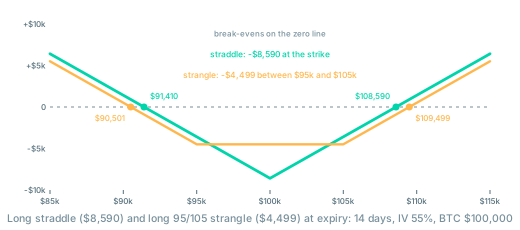
The straddle's price is the market's own estimate of the average absolute move to expiry, which is why lesson 3 uses it as the test for any option purchase: 0.8 × 55% × √(14/365) ≈ 8.6%. Buying the straddle is a statement that Bitcoin will move more than the market expects, in one direction or the other, within two weeks.
The strangle
Buy the 14-day $95,000 put ($2,153) and the 14-day $105,000 call ($2,346). Cost: $4,499, 4.5% of spot.
Between the strikes both legs expire worthless and the loss is the full premium, across a $10,000 band rather than at a single point. The break-evens are the strikes plus the premium: $90,501 and $109,499. The strangle needs a slightly larger move than the straddle to profit and loses half as much when the move does not come.
| 14-day, IV 55% | Long straddle | Long strangle 95/105 |
|---|---|---|
| Cost | $8,590 | $4,499 |
| Maximum loss | $8,590, at $100,000 | $4,499, anywhere from $95,000 to $105,000 |
| Break-evens | $91,410 / $108,590 | $90,501 / $109,499 |
| P&L at $110,000 | +$1,410 | +$501 |
| P&L at $95,000 | −$3,590 | −$4,499 |
| Gamma per $1,000 | 0.074 | lower: both legs are away from the strike |
| Theta per day | −$307 | lower, and it falls further as price leaves the strikes |
| Vega per point | $156 | lower |
The straddle owns the most gamma available in a simple structure, and pays the most theta for it. The strangle is the same view with less of both: cheaper to hold through a week of waiting, slower to respond when the move starts.
Before expiry
The V of the payoff chart applies only at expiry. Before it, both legs carry extrinsic value and the position's value is a curve above the V: at 14 days it is worth what was paid at the strike and more either side; after seven quiet days at unchanged IV it is worth $6,076, a loss of $2,515, and still curved.
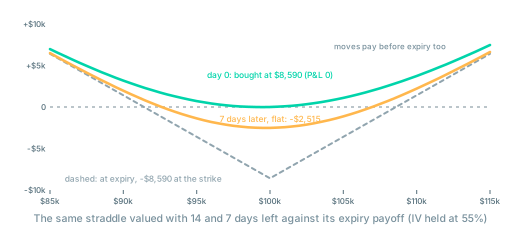
Three things move the curve. Price: a move either way raises it, because the leg on the winning side gains faster than the losing leg loses. Time: each day lowers it, fastest at the strike. Implied volatility: both legs are long vega, so a rise in IV lifts the whole curve and a fall lowers it. A trader who buys a straddle before an event is long all three: the move, the passage of time (against), and the IV, and the IV usually falls after the event. Lesson 4 showed the event straddle losing after a 2% move for that reason.
A straddle is rarely held to expiry. It is closed when the move arrives, while the losing leg still has extrinsic value to sell, or it is delta-hedged as the position of lesson 9, where the payoff chart stops mattering and realised-versus-implied is all that is left.
Selling them
A short straddle collects $8,590 and keeps all of it only if BTC settles at exactly $100,000; a short strangle collects $4,499 and keeps it anywhere inside $95,000 to $105,000. Both lose without limit outside the break-evens.
The risk is not symmetric with buying, and the asymmetry is in the speed. Sold, the position is short gamma: as price moves away from the strikes its delta grows against the seller, faster the closer to expiry. A short 95/105 strangle sold for $4,499 is worth about $11,256 after a 15% fall in three days with IV at 70%: a loss of $6,757, one and a half times the credit, on a position that was collecting about $275 a day of theta. Professional sellers of these structures delta-hedge continuously and size the position to the crash, not to the credit; retail sellers who do neither are the subject of lesson 8.
Synthetic straddles with the perpetual
The perpetual market is far deeper than the options market, and a trader who wants the straddle's exposure can build it from calls alone, or puts alone, plus the perpetual. The rule that makes this work is put-call parity: a call and a put at the same strike and expiry differ only by the underlying, so call − put = spot − strike (ignoring the small interest term), and any put can be rebuilt from a call plus a short position in the underlying.
That gives a synthetic straddle: two calls plus a short of one BTC. The two calls are the call leg twice; the short BTC turns one of them into a put. Its delta at inception is 2 × 0.52 − 1 = 0.04, close to neutral, and its payoff at expiry is the same V. Equivalently, two puts plus a long of one BTC.
A common mistake is to build it with one call and a short of one BTC. That position has a delta of 0.52 − 1 = −0.48: it is a synthetic put, not a straddle, and it is a short directional trade with a floor. The straddle needs two options for every unit of the underlying.
Half of a synthetic straddle is one call against a short of 0.52 BTC, which is exactly the delta-hedged long call of lesson 9. The two positions are the same thing; the straddle is the version that ignores the hedge and the volatility trade is the version that manages it.
The reasons to prefer the synthetic: one option spread instead of two, the perpetual's liquidity for the second leg, and the ability to adjust the hedge without touching the option. The reasons against: funding on the perpetual leg, and a hedge that has to be managed rather than bought once.
Reading the straddle price as a scalper
The at-the-money straddle for the nearest expiry is the cleanest read of the market's expected move over that horizon, and it costs nothing to look up. The 1-day straddle priced at 2.3% says the market expects a 2.3% day; a scalper can compare that with the ATR and with the range of recent sessions before deciding on stop distances and targets. When the straddle is priced well above the recent realised range, the market is paying for something: an event, or fear, or both.
Traps
- Buying at high IV. The straddle bought at 75% needs a 12% move at expiry where the one bought at 55% needs 8.6%, and it loses more to the vol crush after the event. The same view costs more when everyone shares it.
- Holding to expiry by default. The losing leg's extrinsic value is worth selling; the winning leg's convexity is worth keeping. A straddle held to expiry throws away the first and pays full theta for the second.
- Judging the strangle by its low price. $4,499 buys a $10,000 band in which nothing is earned. The lower cost is a lower probability of payment, priced correctly.
- Selling for the theta. $307 a day is the pay; the crash is the job. A seller who has not sized for the second has not understood the first.
Checklist
- The straddle price for the expiry, as the market's expected move, against the trader's own estimate of the move.
- IV against its recent range: buying at a high, or a low?
- Break-evens at expiry and, for a shorter holding, the value of the position after the planned number of days at unchanged IV.
- The exit: close on the move, hedge as a volatility trade, or hold, decided before entry.
- For a sold structure: the loss at a 15% move with IV up 15 points, and whether the account survives it.
Where to go from here
- Crypto options spreads: the defined-risk structures, verticals, calendars and butterflies, that buy or sell a part of the payoff rather than the whole of it.
Related guides:
- Crypto volatility trading: the delta-hedged straddle and the gamma-theta arithmetic.
- IV crush: the event straddle and the priced-in move.
- Options Greeks explained: the gamma, theta and vega the straddle concentrates.
- Selling options for income: what the short side carries.
- Options risk management: the stress grid for a straddle across price and IV.
- Crypto options for beginners: the track hub.
- Glossary: call option, put option, implied volatility, gamma.
This article is educational content, not investment advice. Trading derivatives carries substantial risk, including total loss of capital. See disclaimer.