Crypto Volatility Trading with Options: Long vs Short Vol
TL;DR. Buy an option, sell enough of the perpetual to cancel its delta, and what remains is a position on one thing: whether Bitcoin moves more or less than the option's implied volatility says. Options volatility trading is the business of that difference. The long side owns gamma and pays theta, earning on the days the market moves more than about 2.9% and losing on the days it moves less; the short side is the mirror. This is how options desks trade and how the dealers on the other side of every retail order manage their books. The limitation is that the profit is path-dependent and the hedge costs money every time it is adjusted: a correct forecast of volatility can still lose to the spread and to the timing of the moves.
Prerequisites for this lesson: Options Greeks (gamma and theta as one trade-off), Implied volatility and skew (the volatility risk premium), Selling options for income (what unhedged short volatility looks like). Lesson 9 of the options track.
Two dimensions of price
A directional trader asks where the price will be. A volatility trader asks how much it will move on the way, and the two questions are independent. A market that ends the month where it started can have travelled 40% in between; a market that trends cleanly to a new level can have done it in small, quiet steps. Options are priced on the second question, and a position can be built that answers it without taking a view on the first.
The instrument is the delta hedge. An option has a delta; the perpetual has a delta of one. Sell perpetual against a bought call in the ratio of the call's delta and the combined position has, for the moment, no directional exposure. What it keeps is gamma, theta and vega, and the gamma is the part that turns movement into money.
Long volatility: the mechanism
Buy the 14-day $100,000 call at $4,295 with BTC at $100,000 and 55% IV. Its delta is 0.52, so sell 0.52 BTC of perpetual. The position is delta-neutral.
BTC rises to $102,000. The call's delta has grown to about 0.59 (gamma at work), so the position is now net long 0.07 BTC. To stay neutral, sell 0.07 BTC at $102,000. BTC falls back to $100,000: delta is back to 0.52, the position is net short 0.07 BTC, so buy 0.07 BTC at $100,000. The round trip sold at $102,000 and bought at $100,000, for a gain of $140, and the option is back where it started.
Every oscillation does the same: the hedge sells after rises and buys after falls, because that is what keeping delta at zero requires, and each rebalance locks in a small profit. The larger the move before the rebalance, the larger the profit, and it grows with the square of the move: a $2,000 swing earns about $74 per rebalance from gamma, a $4,000 swing about $296.
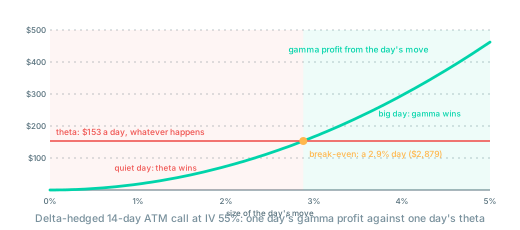
Against that, theta: $153 a day on this call, paid whether or not the market moves. The position is a bet that gamma earnings will exceed theta payments over the life of the option.
The break-even day
The chart contains the entire economics of the position. For the 14-day at-the-money call:
| Day's move | Gamma profit | Theta | Net for the day |
|---|---|---|---|
| 1.0% ($1,000) | $18 | −$153 | −$135 |
| 2.0% ($2,000) | $74 | −$153 | −$79 |
| 2.9% ($2,879) | $153 | −$153 | $0 |
| 4.0% ($4,000) | $296 | −$153 | +$143 |
| 5.0% ($5,000) | $462 | −$153 | +$309 |
The break-even day is a 2.9% move, and 2.9% is 55% divided by the square root of 365: the daily standard deviation implied by the option's own volatility. That is not a coincidence; it is the model's identity. An option bought at 55% IV breaks even, delta-hedged, when the market realises 55%. It earns when the market realises more and loses when it realises less. Over the 14 days, if Bitcoin realises 40% the position loses roughly $1,170, and if it realises 70% it earns roughly the same, which is the option's vega of $78 multiplied by the 15-point gap.
So the trade is: buy volatility when the market will move more than implied, sell it when the market will move less. Everything else is execution.
Short volatility: the mirror
Sell the same call, receive $4,295, buy 0.52 BTC of perpetual to neutralise. Now theta is income, $153 a day, and gamma is the cost: as BTC rises the sold call's delta grows against the seller, who must buy more perpetual at higher prices; as it falls, sell at lower ones. The hedge buys high and sells low, and each rebalance costs what the long side earned. The seller keeps the theta only on days the market moves less than 2.9%.
The delta hedge is what makes short volatility survivable. Lesson 8 showed the unhedged version: a short put whose delta runs to one in a crash, so that the seller is long a whole Bitcoin at the worst moment. Hedged, the seller's exposure is limited to the gamma between rebalances rather than the entire move. The loss in a crash is still large, because gamma is largest exactly when the market moves fastest, and a gap cannot be hedged at all: the hedge is executed at the price after the gap, not during it.
Why this matters to a perpetual trader
The dealers on the other side of every retail option are running this position, on both sides, all the time. When retail buys calls, the dealers sell them and hedge by buying perpetual; when price rises, the sold calls' delta grows and the dealers buy more. That flow is mechanical, it is largest at the strikes with the most open interest and in the days before expiry when gamma peaks, and it is visible on the tape as buying that appears on rallies and selling that appears on dips, or the reverse, depending on the sign of the dealers' book. Lesson 13 reads it from the perpetual side.
The same identity gives a perpetual trader a free forecast. Implied volatility is the market's price for movement, and it is usually above what follows: sellers of options collect that gap, on average, as the volatility risk premium. When DVOL is far above recent realised volatility, options are expensive and the market is paying for movement it will probably not get; when it is below, the reverse, and expansions start from there.
Practicalities
Rebalancing frequency. Hedging continuously is impossible and hedging often is expensive: every rebalance crosses a spread and pays a fee. Hedging rarely leaves delta exposure between adjustments, which adds noise to the result. Desks hedge to a delta band (rebalance when net delta exceeds a chosen size) rather than on a clock. A simulation of a hedged position with a 0.1% spread in the underlying shows the expected profit falling by a fifth when the hedge is adjusted five times a day instead of weekly: the costs are real and they accumulate quietly.
Calls and puts are interchangeable. A bought put hedged with a long perpetual has the same gamma, theta and vega as a bought call hedged with a short perpetual, by put-call parity. Choose the leg with the tighter spread.
Path dependence. Gamma is largest at the strike. If BTC trends away from $100,000 early and stays away, the call becomes a low-gamma, low-theta instrument and the position stops earning from oscillations, whatever the realised volatility of the trend. The same annual volatility can be realised as a steady drift (bad for the long) or as violent oscillation around the strike (very good). Two traders with the same correct forecast can have opposite results.
Size. The house example is on 1 BTC. At the minimum 0.1 BTC contract the numbers divide by ten: $15 of theta a day against gamma profits of a few dollars per rebalance, and a perpetual hedge of 0.05 BTC that must be adjusted by hundredths. The structure works at institutional size and is cumbersome at retail size, where the fees of rebalancing are a large share of the gamma being harvested.
Traps
- Long volatility in a quiet market. Theta is certain and gamma is conditional. A long position started at 55% IV in a market realising 35% loses about $1,500 over two weeks with no error other than timing.
- Short volatility with a wide delta band. The gap between rebalances is where the crash loss lives. A seller who hedges "when it gets big" has an unhedged position at exactly the wrong time.
- Forgetting vega. The position is priced at 55%. If IV moves to 65% the next day, the long side is up $780 before any hedge and the short side down by the same, regardless of what price did. Vega is a separate bet carried alongside gamma.
- Hedging on the wrong price. Deribit options settle to an index; the perpetual trades at its own price with funding. Hedge with the instrument whose price the option's delta is computed against, and account for the funding the hedge pays or receives.
Checklist
- Implied volatility of the option against recent realised volatility: which is higher, by how much, and why.
- The break-even daily move (IV ÷ 19.1) and how many recent days exceeded it.
- The rebalancing rule, written down: delta band, instrument, venue, and the fee per rebalance.
- Theta per day multiplied by the planned holding period, as the total that gamma must earn.
- The vega of the position and the size of IV change the trader is willing to carry.
Where to go from here
- Straddle vs strangle: the structures that express a volatility view without a perpetual hedge, and the synthetic versions that use one.
Related guides:
- Options Greeks explained: gamma and theta, the two sides of the position.
- Implied volatility and skew: the price of movement and its usual bias.
- Selling options for income: short volatility without the hedge.
- Gamma exposure: the market's aggregate version of this position and its footprint on the perpetual.
- Options risk management: the stress test for both sides.
- Position sizing and risk management: the R budget the theta bill comes out of.
- Crypto options for beginners: the track hub.
- Glossary: gamma, theta, vega, volatility risk premium.
This article is educational content, not investment advice. Trading derivatives carries substantial risk, including total loss of capital. See disclaimer.