How to Hedge Crypto with Options: Protective Puts Explained
TL;DR. A put bought against a Bitcoin holding is insurance: a premium paid up front, a floor under the position below the strike, and nothing back if the floor is never reached. To hedge crypto with options is to answer one question honestly: is the protection cheaper than the risk it removes? On 1 BTC at $100,000, a two-week put 5% below the market costs about $2,150 at ordinary volatility, and rolling that protection every month costs on the order of a third to a half of the holding per year. The limitation is that price: continuous protection on Bitcoin is close to uneconomic, and the hedge earns its cost only through specific windows, on holdings large enough that the premium is small against them, bought before volatility rises rather than after.
Prerequisites for this lesson: Crypto options explained (the put, intrinsic and extrinsic value), Implied volatility and skew (why puts are priced above calls), Options vs perpetual futures. Lesson 7 of the options track.
The protective put
A trader holds 1 BTC at $100,000 and wants to keep it through the next two weeks: a macro decision, a large expiry, a period of unclear direction. Selling is one answer, but it gives up the upside and it may have tax or custody reasons against it. The other is a put.
The hedge: buy a 14-day put with a $95,000 strike. At 55% implied volatility the premium is about $2,153, or 2.15% of the holding.
| BTC in two weeks | Holding | Put at expiry | Net, hedged | Net, unhedged |
|---|---|---|---|---|
| $85,000 | −$15,000 | +$10,000 − $2,153 | −$7,153 | −$15,000 |
| $97,000 | −$3,000 | $0 − $2,153 | −$5,153 | −$3,000 |
| $108,000 | +$8,000 | $0 − $2,153 | +$5,847 | +$8,000 |
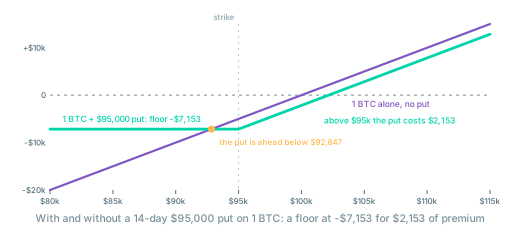
The floor is at −$7,153: the $5,000 from $100,000 to the strike, plus the premium, and no further loss however far BTC falls. Everywhere above $95,000 the hedge costs its premium and nothing else: the small dip and the rally both end $2,153 worse than holding alone. The put is ahead of the unhedged holding only below $92,847. That is the whole deal, and it is the deal of every insurance policy: paid for whether or not it is used, and worth it only in the outcome it was bought for.
What sets the price
Distance from the market. The $95,000 put is 5% out of the money. A $97,000 put would cost more and set a higher floor; a $90,000 put would cost less and set a lower one. The premium is the price of the floor's height.
Time. Fourteen days of protection costs $2,153; thirty days of the same strike costs about $3,950. Protection is priced by the square root of time, so two weeks is more than half the price of a month.
Implied volatility. The largest input and the least visible. The same 30-day $95,000 put costs about $2,400 at 40% IV, $3,950 at 55% and $5,550 at 70%. Puts are bought when holders are afraid, which is when IV is high, which is when they cost most. The skew of lesson 3 adds to it: the put wing carries a higher volatility than the at-the-money, so the $95,000 put is priced above what the flat 55% would give. The hedger who buys before the fear rather than during it pays a fraction of the price.
The cost of continuous protection
A holder who wants a floor at all times must buy a new put as each one expires. This is rolling, and the annual bill is the number most hedging pitches leave out.
| Implied volatility | 30-day $95,000 put | Per month | Per year, rolled monthly |
|---|---|---|---|
| 40% | $2,396 | 2.4% | about 29% |
| 55% | $3,948 | 3.9% | about 47% |
| 70% | $5,545 | 5.5% | about 67% |
At the ordinary 55%, permanent 5% protection on a Bitcoin holding costs close to half the holding per year. There is no cycle in which that is paid back by the floors it provides. Institutional holders who protect continuously do it at lower strikes, on part of the position, or by selling a call against the put to finance it (a collar: the 30-day $95,000 put at $3,948 against a sold 30-day $110,000 call at $2,765 costs $1,183 a month and caps the upside at $110,000). Retail holders who roll puts monthly at the money are paying an annuity to the options market.
The conclusion is not that puts are useless; it is that they are a tool for windows. Two weeks around an event, at 2% of the holding, on a position the holder cannot or will not reduce, is a purchase that can make sense. Twelve months of it does not.
When the put makes sense
- A large holding through a specific risk window. The premium on $100,000 of BTC is $2,153 for two weeks; on $500,000 it is $10,765 to protect against a loss that could be $75,000. The relative cost is the same, and the absolute loss avoided is what makes the decision.
- A holding that cannot be reduced. Tax, custody, a lock-up, a commitment: when selling is not available, the put is the way to cut exposure without selling.
- Volatility bought low. A put at 40% IV is 60% of the price of the same put at 55%. The hedge is cheapest when it looks least necessary.
- A holding period of days to weeks. The premium is earned against a window long enough for the feared move to happen and short enough that theta does not eat the floor.
When it does not
- For a scalp. A perpetual position held for minutes cannot pay for any option. The stop is the hedge, and it costs nothing until it is hit.
- When IV is already elevated. DVOL at 80 means the put costs half as much again as usual, and the market has already priced the fear the buyer is protecting against. Whatever the crash does, the vol crush after it will take part of the put's value back.
- When size can simply be reduced. Selling half of the holding removes half the risk for a round-trip fee, immediately, with no theta and no expiry. Before any put is priced, this is the alternative to price first.
- When the floor is below where the holder would sell anyway. A put 10% below the market protects against nothing the holder would have tolerated; it is a lottery ticket on a crash.
The alternatives
A stop-loss closes the position at a set level, for nothing until it triggers. Its weakness is the one the put fixes: in a liquidation cascade or a gap, it fills late and badly, and the put's floor holds through both. For a holding of days on a liquid market, the stop is usually the better tool; for a holding through a known event, the put is.
Reducing size is the zero-cost hedge. A $50,000 position that causes worry is a $25,000 position with the same view.
A short perpetual against the holding neutralises it for the funding cost and nothing else. It removes the upside as well as the downside, which for a trader who wants to be out for a while is the point.
A collar finances the put with a sold call and caps the upside. It is the standard institutional structure for continuous protection because it makes the roll affordable, at the price of the rallies.
Traps
- Buying the hedge after the move has started. IV is highest in the fall. The put bought on the second day of a crash costs twice what it cost the week before and protects against less.
- Counting the premium as the only cost. The put also carries theta and vega: a hedge bought at high IV loses value when the market calms, whether or not the price fell.
- Confusing a hedge with a trade. A put bought as a hedge is a cost centre. A put bought as a bet on a fall is a directional trade with a 4R premium, sized as such.
- Rolling by habit. Each roll is a new purchase that should be justified on its own: the window, the size, the IV. A hedge renewed automatically becomes the largest expense in the account.
Checklist
- What is being protected, for how long, and against what specific risk?
- Can the position be reduced instead, and what would that cost?
- The premium in dollars and as a percentage of the holding; the floor it sets; the price below which the hedge is ahead.
- Where IV sits against its recent range, and what the same put cost a month ago.
- If the protection is to be renewed: the annual bill at the current IV, written down, before the first purchase.
Where to go from here
- Selling crypto options for income: the other side of the protective put, where the premium is received rather than paid, and the month that gives back the year.
Related guides:
- Crypto options explained: the put and its intrinsic value.
- Implied volatility and skew: why the put wing is the expensive one.
- Options Greeks explained: theta and vega on the hedge after it is bought.
- Crypto futures trading: the short perpetual as the other way to neutralise a holding.
- Position sizing and risk management: the alternative that costs nothing.
- Crypto options for beginners: the track hub.
- Glossary: put option, premium, strike price, implied volatility.
This article is educational content, not investment advice. Options trading involves substantial risk and is not suitable for all investors. See disclaimer.