Crypto Options Spreads: Vertical, Calendar & Butterfly
TL;DR. A spread buys one option and sells another against it, so that the sold leg pays for part of the bought leg and caps part of its payoff. Options spreads explained by what each one keeps: a vertical keeps direction with a defined loss and a defined gain; a calendar keeps the difference in time decay between two expiries; a butterfly keeps a bet that price settles near one strike. On 14-day Bitcoin options at 55% volatility the 100/105 bull call spread costs $1,949 against $4,295 for the naked call, and the 95/100/105 butterfly costs $909 for a maximum of $4,091. The limitation is the cap: every dollar of premium saved is paid for with payoff given up, and a spread that is right on direction can still finish under the naked option in a large move.
Prerequisites for this lesson: Crypto options explained, Options Greeks, Straddle vs strangle. Lesson 11 of the options track.
Why spreads exist
A single bought option has three costs. It is expensive: the 14-day at-the-money call is $4,295, 4.3% of spot, for a two-week view. It decays: $153 a day from the start. And it is long vega: a fall in implied volatility takes value out of it with the price unmoved. Selling a second option against the first reduces all three, because the sold leg is also expensive, also decays, and also loses value when IV falls, and those losses on the sold leg are gains to the position.
The price of the reduction is a cap. The sold leg gives away the payoff beyond its strike, or beyond its expiry, or on both sides of a centre. A spread is a way to buy only the part of the payoff the trader has a view on, and to sell the rest back to the market.
Vertical spreads: direction with a defined loss
Same type, same expiry, two strikes.
Bull call spread. Buy the 14-day $100,000 call at $4,295, sell the 14-day $105,000 call at $2,346. Net cost: $1,949.
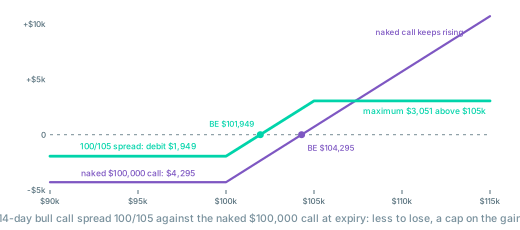
- Below $100,000: both calls expire worthless. Loss $1,949, the maximum.
- Between the strikes: the bought call has value, the sold one does not. Break-even at $101,949.
- Above $105,000: both are in the money and the spread is worth its width, $5,000. Profit $3,051, the maximum, at $105,000 and at $150,000 alike.
Against the naked call: the spread risks $1,949 to make $3,051 and breaks even $2,346 lower. The call risks $4,295, breaks even at $104,295 and has no cap. At $110,000 the spread makes $3,051 and the call $5,705; at $103,000 the spread makes $1,051 and the call loses $1,295. The spread is the better trade for a moderate move and the worse one for a large move, which is the choice it offers.
Bear put spread. The mirror: buy the 14-day $100,000 put at $4,295, sell the $95,000 put at $2,153. Cost $2,142, maximum profit $2,858 below $95,000.
The spread's Greeks are the difference of its legs. The bull call spread has a delta of 0.18 (0.52 − 0.34), a vega of about $6 per point and a theta of about −$12 a day: a fraction of the naked call's $78 and −$153. That is the point of the structure: a directional position with most of the volatility and time exposure removed, and it is what allows a directional view to be held through an event without the vol crush deciding the outcome.
Width sets the trade-off. A 100/110 spread costs more ($3,130) and pays up to $6,870; a 100/102 spread costs less and pays little. The width is chosen from the size of the expected move, not from the price of the spread.
Calendar spreads: selling the front, owning the back
Same strike, same type, two expiries.
Sell the 7-day $100,000 call at $3,038; buy the 30-day $100,000 call at $6,284. Net cost: $3,246.
The position earns from the difference in decay. The 7-day option loses $217 a day and the 30-day loses $105, so the spread collects about $112 a day of net theta while price stays near the strike. At the front expiry with BTC still at $100,000, the sold call expires worthless, the bought call has 23 days left and is worth about $5,504, and the position shows a profit of about $2,257 at unchanged IV.
It loses if price leaves the strike. At $94,000 on the front expiry the long call is worth $2,865 and the position loses $381; at $106,000 the sold call is worth $6,000 of intrinsic value against a long call worth $9,165, and the position loses $81. Large moves either way hurt, and the profit sits in a band around the strike.
The calendar is also a position on the term structure of lesson 3. It is short front-month vega and long back-month vega, so it gains when front IV falls relative to back IV, which is what happens when a scheduled event passes: the front expiry carried the event premium and loses it, the back expiry did not carry as much. A calendar sold across an event date is the defined-risk way to sell the event's volatility. It loses when front IV rises further, which is what happens if the event turns into a crisis.
Butterflies: one strike, cheaply
A long call butterfly: buy one $95,000 call ($7,153), sell two $100,000 calls ($4,295 each), buy one $105,000 call ($2,346), all 14-day. Net cost: $909.
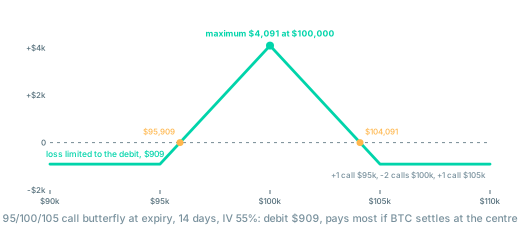
- At $100,000: the $95,000 call is worth $5,000, the other three expire worthless. Profit $4,091, the maximum.
- Below $95,000 or above $105,000: the legs cancel. Loss $909, the maximum.
- Break-evens at $95,909 and $104,091.
The butterfly is cheap because it is a bet on a narrow outcome: BTC within about 4% of the centre in two weeks, in a market whose expected move is 10.8%. A payoff of 4.5 times the cost is the market's price for that probability. It is the structure for a precise view on where price settles, which is why it appears around max pain and around large-open-interest strikes before an expiry: a small premium for the chance that dealer hedging holds price at the centre.
Its Greeks are those of a short straddle at the centre with the wings bought back: short gamma and short vega near the strike, positive theta. It earns from time and from falling IV if price stays put, with the loss on a large move limited to the debit rather than open-ended.
Choosing the structure
| View | Structure | What is kept | What is given up |
|---|---|---|---|
| Up, moderately, with a defined loss | Bull call spread | Direction, low vega and theta | The move beyond the upper strike |
| Down, moderately | Bear put spread | The same, mirrored | The move below the lower strike |
| Flat near a level for a week, or front IV too high | Calendar | Net theta, long back vega | Large moves either way |
| Settles at one strike, cheaply | Butterfly | A large payoff for a small debit | Almost every other outcome |
| A large move either way | Straddle or strangle | Gamma | Theta, every day |
The width and the strikes come from the expected move, which comes from IV. A bull call spread whose upper strike sits beyond the expected move is a cheap spread that will not reach its maximum; one whose upper strike is inside it gives up gains the view predicted.
Execution
Deribit trades multi-leg structures as combo orders with a reduced fee, so a spread can be entered as one order at a net price rather than legged. Legging (buying one option and then selling the other) exposes the trader to the market moving between the two fills and to paying two spreads. Enter the structure as one order, at a limit, and check the net Greeks the platform shows against the ones expected before confirming.
Margin matters for the sold legs. A bought spread's maximum loss is its debit and Deribit margins it as such; a calendar's sold front leg and a butterfly's two sold centre calls are covered by the bought legs and the margin is small. Selling a leg without a bought leg covering it is a different position with the margin and risk of lesson 8.
Traps
- Capping the move the view predicted. A trader expecting $110,000 who buys the 100/105 spread has sold the part of the trade they believe in most.
- Reading the calendar as riskless. It loses on a large move in either direction and on a rise in front-month IV, which is what a crisis produces. It is a short-volatility position with a defined loss, not a free carry.
- Butterflies far from the money. A butterfly centred 8% away costs almost nothing and pays almost never. The cheap price is a correct estimate.
- Legging into a spread. The market moves between the fills; the net price is not the one that was modelled.
Checklist
- The view: direction, size of move, timing, and whether IV is high or low against its range.
- The structure that keeps that part of the payoff and gives up the rest, with strikes set from the expected move.
- Maximum loss, maximum gain and break-evens at expiry, written down; the value after the planned holding period at unchanged IV.
- The net Greeks, especially vega across any event inside the holding period.
- The order: one combo at a limit, with the fee and the margin known before it is sent.
Where to go from here
- Crypto options risk management: the Greeks as risk sensors, the stress test that moves price and IV together, sizing and liquidity, for every structure in the track.
Related guides:
- Options Greeks explained: where each spread's Greeks come from.
- Straddle vs strangle: the structures that keep gamma instead of selling it.
- Implied volatility and skew: the term structure the calendar trades.
- Bitcoin options max pain: the level a butterfly is often centred on.
- Position sizing and risk management: the debit as the R at risk.
- Crypto options for beginners: the track hub.
- Glossary: call option, put option, theta, vega.
This article is educational content, not investment advice. Trading derivatives carries substantial risk, including total loss of capital. See disclaimer.