Crypto Options Risk Management: Greeks, Stress Tests & Sizing
TL;DR. An options position carries four risks at once: direction, the speed at which direction changes, time and volatility, and they arrive together rather than one at a time. Options risk management is the habit of pricing the position under the combinations before entry, sizing it by the worst plausible cell rather than the premium, and deciding the response to each cell in advance. The tool is a stress grid: the position's value at several prices and several implied volatilities, a week later. The limitation is that the grid is a model, and the moves that matter most are the ones where the model's assumptions fail: a gap that cannot be hedged, a book that widens, an IV that jumps further than the grid allowed.
Prerequisites for this lesson: Options Greeks, Crypto options spreads, Position sizing and risk management (the R unit). Lesson 12 of the options track.
The four risks
A perpetual position has one risk: price goes the wrong way. An options position adds three more, and each has a Greek that measures it:
- Price goes the wrong way (delta).
- Price goes the right way, but slowly, and time takes more than the move gives (theta).
- Implied volatility falls, and the position loses with price unchanged (vega); or rises, against a seller.
- The exposure changes as price moves, so that the position after a 5% move is not the position that was sized (gamma).
They are not independent. A crash is a fall in price, a rise in IV and a jump in gamma at once; a relief rally is a rise in price with a fall in IV. Reading the Greeks one at a time, at today's price and today's IV, describes a position that will not exist tomorrow.
The Greeks as sensors
Delta is the position in BTC. Delta × contracts is the exposure a perpetual trader would recognise, and it is checked against the size that trader would accept as a perpetual position. A 0.34-delta call on 1 BTC is 0.34 BTC of exposure today.
Gamma is how fast that changes. The check that matters for a short position: what is the delta after a 5% adverse move? A short 95/105 strangle that is delta-neutral at $100,000 has a delta of about +0.5 BTC after a fall to $95,000 with a week left, and the delta keeps growing. The exposure in the stress case is the exposure to size for.
Theta is the daily cost or income. Theta × days of the plan is the sum the move must earn beyond the premium, and for a seller it is the income that the gamma risk is being carried for.
Vega is the sensitivity to the market's fear. Vega × a plausible IV change is the loss that arrives without any price move at all. Before any scheduled event, the plausible change is ten to twenty points down for a buyer and up for a seller.
The stress grid
The method that combines them: revalue the position at a set of prices and a set of implied volatilities, at a date inside the holding period. The 14-day $100,000 straddle of lesson 10, bought for $8,590, valued seven days later:
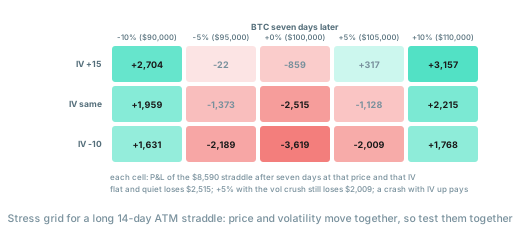
| Seven days later | BTC −10% | −5% | unchanged | +5% | +10% |
|---|---|---|---|---|---|
| IV +15 (70%) | +$2,704 | −$22 | −$859 | +$317 | +$3,157 |
| IV unchanged (55%) | +$1,959 | −$1,373 | −$2,515 | −$1,128 | +$2,215 |
| IV −10 (45%) | +$1,631 | −$2,189 | −$3,619 | −$2,009 | +$1,768 |
Three readings from the grid that no single Greek gives:
- A 5% move in a week is not enough. Every cell in the ±5% columns is a loss except the crash with IV up. The straddle's expected move was 8.6% at expiry, and after seven days a 5% move has not paid for the theta.
- The vol crush is a second loss on top of the first. The +5% cell goes from −$1,128 to −$2,009 when IV drops ten points; a correct reading of a rally is undone by the calm that follows it.
- The crash is the only comfortable row. A fall with IV rising is the one combination that pays a long straddle handsomely, which is why long volatility positions are bought as crash insurance and why they cost what they do.
The same grid for a sold structure is the mirror, and the cell to read is the one with the largest loss: the short 95/105 strangle of lesson 10, sold for $4,499, is worth $11,256 after a 15% fall in three days with IV at 70%, a loss of one and a half times the credit. That cell is what the position is sized to.
The grid is built with the platform's position analysis or with any option calculator: five prices, three volatilities, one date. It takes ten minutes and it is the difference between knowing the position and having it explained afterwards.
Sizing
Options positions are sized in R like every other position, with one change: the risk is not the premium but the worst plausible cell.
- Bought options and debit spreads. The maximum loss is the premium or the debit, and the sizing rule applies to it directly: the 0.1 BTC at-the-money call at $430 is 4.3R on the $10,000 house account, which is already outside the rule for a single position. Small accounts trade the smallest contracts, or defined-risk spreads, or nothing.
- Sold options. The maximum loss is not the credit; it is the grid's worst cell, and it is often a multiple of the credit. A seller who allocates 2R to a short strangle sizes it so that the −15%, IV +15 cell loses about 2R, which on the house account means a fraction of one minimum contract, which means the trade does not exist at that account size. That conclusion is correct.
- Hedged volatility positions. The risk is the gap between rebalances plus the vega exposure, sized from the grid at the delta band's width.
The common failure is sizing by the credit received, because the credit is the number on the screen. The credit is the maximum gain. Sizing by it is sizing by the best case.
Liquidity
Options books are thinner than the perpetual's and they widen when it matters.
- At-the-money BTC and ETH options on Deribit have tight spreads in normal conditions; far strikes, short expiries and other underlyings can show spreads of 10% to 30% of the option's value.
- The spread is paid twice, on entry and on exit, and a position that cannot be exited at a fair price has a larger maximum loss than the grid shows.
- In the last hours before expiry, out-of-the-money options lose their market. A position that needs to be closed then may find no bid.
- Size against the book: a position that would take several resting orders to unwind in normal conditions is too large for a stress exit.
Adjustment rules
Not every adverse cell needs action; the response is decided before entry, per cell.
- The view has changed. Close. The position was built for a thesis that no longer holds, and the remaining extrinsic value is worth more sold than held.
- The position is inside its risk budget and the view holds. Do nothing. The most common correct action, and the hardest.
- The Greeks have moved outside tolerance. Reduce, or hedge the Greek that has grown: a short put under pressure is hedged with a further put bought below it, which converts an open-ended loss into a defined one at the cost of some credit; a delta that has grown is hedged with the perpetual.
- Roll. Close the position and open it again at other strikes or a later expiry. This is two decisions, an exit and a new entry, and the second should be justified on its own rather than as a way to avoid realising the first.
Traps
- Reading the Greeks at today's price. The short strangle's delta of zero is true for one price. The stress grid's delta at −10% is the one that will need hedging.
- Sizing sold options by the credit. The credit is the best case; the grid's worst cell is the risk.
- Ignoring vega across an event. A bought position that survives the price grid at unchanged IV can lose most of its value in the vol-crush row.
- Assuming an exit. The grid values the position at model prices. In a cascade the option's bid is wider than the model and sometimes absent; the perpetual hedge is the exit that works.
Checklist
- Delta, gamma, theta and vega of the position, and what each becomes after a 5% move against it.
- The stress grid: five prices, three IVs, one date inside the holding period; the worst cell circled.
- The size that makes the worst cell an acceptable number of R, and whether that size exists on the venue.
- The spread on each leg now, and an estimate of it in stress; the exit that works if the option's book does not.
- The response to each adverse cell, written before entry: close, hold, hedge or reduce.
Where to go from here
- Gamma exposure (GEX) explained: the last lesson of the track, from managing the Greeks of one position to reading the aggregate Greeks of the market and their footprint on the perpetual.
Related guides:
- Options Greeks explained: what the four sensors measure.
- Straddle vs strangle: the positions the grid is built on.
- Selling options for income: the position whose worst cell is the largest.
- Crypto volatility trading: the hedged version and its rebalancing risk.
- Risk of ruin: why the worst cell, not the average, sets the size.
- Position sizing and risk management: the R rule that options positions inherit.
- Crypto options for beginners: the track hub.
- Glossary: delta, gamma, vega, premium.
This article is educational content, not investment advice. Trading derivatives carries substantial risk, including total loss of capital. See disclaimer.