Crypto Leverage Explained: Margin, Risk & Liquidation
TL;DR. Leverage lets you control a position larger than your deposit: at 10× a $1,000 margin controls $10,000 of BTC, and gains and losses both multiply by ten. Exchanges offer 100× and more; experienced scalpers use 3× to 10×. Crypto leverage does not add edge, it moves the liquidation price closer, and the only question that matters is how far that price sits beyond your stop. Most beginners choose leverage by the profit they want to make and discover the liquidation distance afterwards, which is the order of operations that ends accounts.
Prerequisites for this lesson: Perpetual futures (the instrument that offers leverage), Crypto order types (the stop-loss). Lesson 5 of the basics section.
What leverage is
When you trade a perpetual future you post margin, a deposit that serves as collateral, and the exchange lets you open a position larger than the deposit. The ratio of position size to margin is the leverage:
- $10,000 position with $1,000 of margin: 10×
- $10,000 position with $500: 20×
- $10,000 position with $100: 100×
Leverage is a tool, and the risk comes from how it is used. The lesson is about the one thing it changes that beginners do not look at.
Leverage sets the liquidation distance
The most important thing leverage decides is how far price can move against you before the exchange closes the position. Before maintenance margin and fees, the distance is simply one divided by the leverage:
| Leverage | Adverse move to liquidation |
|---|---|
| 2× | about 50% |
| 5× | about 20% |
| 10× | about 10% |
| 20× | about 5% |
| 50× | about 2% |
| 100× | about 1% |
The exchange closes the position a little before that, when the remaining margin falls to the maintenance requirement. With a 0.5% maintenance rate, which is in the range major venues use for the lowest position tiers on BTC, 10× is closed at roughly a 9.5% move and 50× at roughly 1.5%. The liquidations lesson has the fuller table and what happens to the market when many of those positions are closed at once.
BTC moves 2% to 5% in an ordinary volatile session. A 100× position is liquidated by intraday noise. A 10× position survives typical volatility and not a bad news event. A 3× to 5× position leaves room to be wrong and still leave on your own terms.
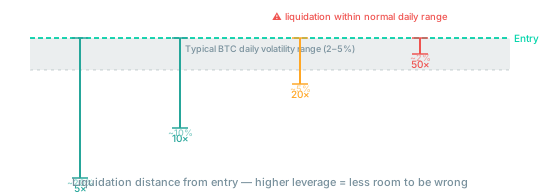
The right question: where is the stop?
Beginners think about leverage as "how much can I make". Experienced traders think about it as "how far is my liquidation from my stop".
The stop-loss must trigger before the liquidation price. If it does not, you are no longer exiting on your own terms; the exchange closes the position for you, by market order, often at the worst price of the move. The workflow that follows from this:
- Decide the stop from the chart, not from a fixed percentage. The support and resistance lesson covers where it goes.
- Size the position from the stop: risk in dollars divided by the stop distance, as the position sizing lesson sets out.
- Choose leverage so that the liquidation price is at least 20% to 30% further from the entry than the stop. That buffer means that even in a fast, gapping market the stop fires before the engine does.
Leverage, in this order, is the last decision and the least important one.
More leverage is not more profit
The misconception: "higher leverage means more money on the same move". The position size decides the dollar P&L, and any position size is available at any leverage by adjusting the margin. What higher leverage forces is a closer liquidation price, which requires a tighter stop, which requires a more precise entry. High leverage is not a shortcut to a larger profit; it is a demand for a precision that most traders do not have when they start.
There is a second cost that is easy to miss. A tighter stop means a larger position for the same risk, and the exchange charges fees on the position. The range fade lesson shows a trade whose fees are 22% of the risk because the stop is 0.18% away. Leverage does not change the fee rate; it invites the stop distance that makes fees large.
Isolated and cross margin
Cross margin. The whole account balance is collateral for every position. A losing position draws on the rest of the balance to stay open, and a runaway loss can drain the account before it is liquidated.
Isolated margin. Only the margin assigned to the position is at risk. If it is liquidated, that margin is lost and the rest of the account is untouched.
For scalping, isolated margin is the default. It caps the loss on one trade at what you assigned to it and stops a single bad position from taking the account with it.
Practical leverage for scalpers
There is no single correct leverage; it follows from the stop distance, the account and the risk per trade. A working frame:
- New scalpers: 2× to 5×, isolated. Not timid. At 3× a $5,000 account controls a $15,000 position, which is real exposure with enough distance from liquidation to survive the mistakes that learning consists of.
- Experienced scalpers: 5× to 15× on tight, well-defined setups. With a stop 0.5% away, 10× puts the liquidation about 10% away, comfortable for intraday work.
- Above 20×. Only with stops under 0.2% and precise execution, which is a description of a professional market maker's book, not a retail trader's. For most people it is damage, not opportunity.
How accounts end
The sequence is the same often enough to have a name, overleveraging into a liquidation:
- Start at 10× to 20× because the potential gains look good.
- Have a few winners and feel confident.
- Increase size or leverage after the wins.
- Get caught in a liquidation cascade or a news candle. The position is closed by the engine. Most of the account is gone.
The remedy is not to avoid leverage. It is to choose it from the stop, not from the profit you have in mind, and the risk of ruin lesson shows what each step of that sequence does to the odds of surviving.
Survival compounds
A trader who risks 1% to 2% per trade at 3× to 5× has flat weeks and slow months, and is still trading six months later, with more skill and a record to learn from. A trader at 50× has some spectacular wins and one session that ends the run. Scalping is a long game, and the traders who last are the ones who set the downside first.
Where to go from here
Leverage is chosen from the stop. The next lesson is the formula that turns the stop into a position size and keeps every trade at the same risk.
- Position sizing and risk management: risk per trade, the sizing formula, ATR stops and portfolio heat.
Related guides:
- Liquidations: what happens when many positions are closed at once, and how to stay out of the cluster.
- Perpetual futures: the instrument that makes leverage available.
- Risk of ruin: how bet size relative to the account decides survival.
- Range fade: why a tight stop makes fees a large share of the risk.
- Crypto scalping basics: the section hub.
- Glossary: leverage, margin, liquidation, isolated margin, cross margin.
This article is educational content, not investment advice. Trading derivatives carries substantial risk, including total loss of capital. See disclaimer.