Narrow Range Scalping Strategy: Entries, Stops & Fakeouts
TL;DR. A narrow range is a consolidation so tight that the fees and the noise inside it are larger than the move you could capture: on BTC, a band of 0.1% to 0.2% around the 5-minute moving average. The narrow range scalping strategy has one rule that matters more than the rest: do not trade inside it. The two tradeable events are the failed poke through an edge (a small sweep that reverses) and the expansion when the range finally breaks. This lesson shows the fee arithmetic that kills inside trades, the sweep trade with honest numbers, and how to recognise the moment the compression turns into a breakout.
Prerequisites for this lesson: Range fade (the base method and the fee test), EMA scalping (the moving average the range forms around), Trade execution (maker and taker fees, slippage). The numbers below reuse the fee assumptions from the range fade lesson: maker 0.02%, taker 0.05%.
What a narrow range is
Markets alternate between movement and rest. Toby Crabel documented this in the 1980s as the contraction and expansion principle: a period of unusually narrow ranges tends to be followed by a period of unusually wide ones, and the direction of the first move out of the contraction tends to continue. Crypto behaves the same way on intraday charts. After a fast move, BTC will often spend thirty minutes to two hours going nowhere, printing 1-minute candles with $20 to $60 bodies while the 5-minute moving average flattens underneath.
That is a narrow range. In practice it has three features:
- Price hugs the moving average. The 5-minute 20 EMA runs through the middle of the candles rather than above or below them. Every push away from it comes back within a few candles.
- The edges are close. Local highs and lows sit 0.1% to 0.2% apart on BTC, roughly $100 to $200 at a $100,000 price. On smaller coins the percentage is wider but the principle holds.
- Volume falls. The candles inside the range trade less than the candles that led into it. Nobody is pressing.
The old advice for this environment is "fade the edges". The section below shows why that advice loses money in a range this tight, and what to do instead.
Why trading inside a narrow range loses
Take a range with a low at $99,930 and a high at $100,080: $150 wide, 0.15%. You buy near the bottom at $99,960 with a target at $100,060 ($100 away) and a stop at $99,910 ($50 away). On paper that is a 2:1 trade. Now add the fees the exchange charges on the full notional of one BTC:
| Fill type | Fees, round trip | Net on a win | Net on a loss | Breakeven win rate |
|---|---|---|---|---|
| Taker both legs (0.10%) | $100 | $0 | −$150 | 100% |
| Maker both legs (0.04%) | $40 | +$60 | −$90 | 60% |
With market orders the winning trade earns nothing: the entire $100 target goes to the exchange. With limit orders you keep $60 of the win and lose $90 on the stop, so you need to be right three times in five just to stand still. No scalper is right 60% of the time inside a $150 band, because inside a band that tight the moves are noise, and noise does not care about your entry.
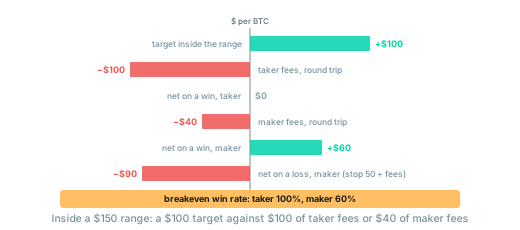
This is the single most common way beginners lose money in quiet markets: not a big loss, but a hundred small trades that each hand a few dollars to the fee schedule. The common mistakes lesson calls it overtrading; the arithmetic above is what overtrading costs. Inside a narrow range, the correct position is flat.
The dead zone around the moving average
A practical way to enforce that is to draw a no-trade band around the EMA. On BTC, ±0.1% of price around the 5-minute 20 EMA (about ±$100 at $100,000) is a reasonable default. When price is inside the band, you are watching, not trading. When price is at the edge of the range, one of two things is about to happen, and both are tradeable.
Trade 1: the failed poke through the edge
Stops accumulate just outside a narrow range. Traders who bought inside the range have stops below the low; traders who shorted have stops above the high; breakout traders have buy stops above the high and sell stops below the low. When price pokes through an edge, those orders fire in a burst and volume spikes. If there is no follow-through, the burst is over in one or two candles and price is back inside. That is a sweep, and the lesson on stop hunts explains the mechanism in full. Here is the trade.
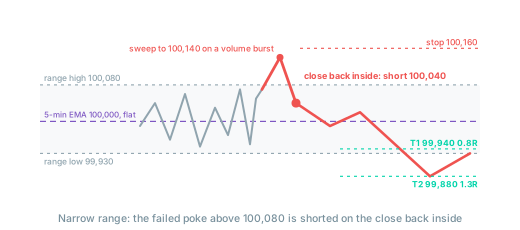
The setup (short after a failed poke above the high):
- The range: low $99,930, high $100,080, forty minutes on the 1-minute chart, EMA flat at $100,000.
- Price spikes to $100,140, sixty dollars above the high, on the highest volume of the session.
- The next 1-minute candle closes at $100,040, back inside the range. That close is the trigger. A candle that closes above $100,080 instead is a breakout, not a sweep, and you do not short it.
- Short at $100,040. Stop at $100,160, above the sweep high. Target 1 at the range low, $99,940. Target 2 at $99,880, a sweep of the other side, because the stops below the low will get run in the same way.
| Item | Value |
|---|---|
| Entry | $100,040 |
| Stop | $100,160 (risk $120 per BTC) |
| Target 1 (range low) | $99,940: +$100, 0.8R |
| Target 2 (sweep of the low) | $99,880: +$160, 1.3R |
| Position for $100 risk | 0.833 BTC, notional $83,400 |
| Maker fees, round trip | $33 (0.33R) |
| Net win at target 2 | 1.3R − 0.33R = 1.0R |
| Net loss | 1.0R + 0.33R = 1.33R |
| Breakeven win rate (maker) | 57% |
Read the last row honestly. Even the best trade in a narrow range needs to win more often than it loses just to cover fees, because the stop has to sit above the sweep and the target is limited by the height of the range. It works when the sweeps are clean and frequent, and it does not work at all with market orders (taker fees of $83 per trade push the breakeven win rate to about 79%). If you take this trade, take it with limit orders, take it only when the reclaim candle closes back inside, and take target 1 on at least half the position.
Trade 2: the expansion
The better trade from a narrow range is the one Crabel's data pointed at: the move that ends the contraction. When a 1-minute candle closes outside the range on volume two to three times the recent average, and the next candle does not come back inside, the range is over and the range breakout rules apply: entry on the confirmation, stop back inside the range, target a multiple of the range height. The narrow range lesson stops at identification. Its job is to keep you flat and alert while the compression builds, so that you have capital and attention when it releases.
The two trades are opposites, and the deciding evidence is the same: what happens on the candle after the edge is breached. Close back inside means sweep, fade it. Hold outside means expansion, go with it. Entering before that candle closes means guessing, and the fee table above shows what guessing costs.
The traps
- Trading the middle. The most expensive habit in quiet markets. A trade at the EMA in a $150 range has no target and no edge; it is a coin flip with a $40 entry fee.
- Shorting the poke before the reclaim. The spike above the high looks like a gift. Half the time it is the first candle of the expansion, and shorting into it puts you on the wrong side of a breakout with a stop that has not been placed yet.
- Averaging into the breakout. Because the range held for an hour, the first close outside feels like another fake. Adding to a losing fade against a real expansion is how a $100 risk becomes a $600 loss; the averaging down section of the mistakes lesson has the arithmetic.
- Ignoring the session. Narrow ranges before a scheduled event (a US data release, a large options expiry at 08:00 UTC) resolve violently. The sweep trade has a worse record in the thirty minutes before such events because the expansion, when it comes, does not stop at the other edge of the range.
- Wide stops to avoid the noise. Moving the stop from $100,160 to $100,300 does not make the sweep trade safer; it makes the position smaller for the same risk and cuts the R on the target by more than half.
Checklist for a narrow range
- Is the range hugging the 5-minute EMA with edges 0.1% to 0.2% apart?
- Am I flat while price is inside the band? (If not, why?)
- Has an edge been pierced, and did the next candle close back inside?
- Is the stop above the sweep wick, and is it 1R or less?
- Is the entry a limit order? What is the fee bill in R?
- Is target 1 at the opposite edge, taken on at least half the position?
- If the candle after the pierce holds outside, do I know the breakout rules?
Where to go from here
The narrow range teaches the discipline of staying out. The next lesson covers the opposite environment, a range wide enough to trade inside, where the midline and partial targets become part of the plan.
- Wide range scalping: edge trades, midline reactions and target ladders in a broad range.
Related guides:
- Range fade: the base method and the fee test in detail.
- Stop hunts and liquidity sweeps: why edges get poked and how to tell a sweep from a breakout.
- Range breakout: the expansion trade when the narrow range ends.
- Common scalping mistakes: overtrading and averaging down, the two ways narrow ranges take money.
- Position sizing and risk management: how 1R and the notional are calculated.
- Crypto scalping strategies: the full strategies track.
- Glossary: range, liquidity sweep, maker, taker.
This article is educational content, not investment advice. Trading derivatives carries substantial risk, including total loss of capital. See disclaimer.