Three-Candlestick Patterns: Morning Star, Evening Star & More
TL;DR. Three-candlestick patterns are the most complete single structures in candlestick analysis. The morning star and evening star are reversals with the confirmation built in: the third candle confirms what the first two suggested. Three white soldiers and three black crows show directional conviction sustained over three periods. They apply at the extremes of extended moves and at levels; in the middle of a range, the same shapes are noise. The limitation is time: three candles on a 5-minute chart is fifteen minutes, and by the time the pattern completes, part of the move it signals has often happened.
Prerequisites for this lesson: Two-candlestick patterns (setup and trigger candles), Single candlestick patterns (the doji and spinning top that form the middle candle). Lesson 4 of the strategies track.
Why three candles matter
A three-candle pattern tells a story in three acts:
- Setup: the prevailing move continues (first candle).
- Uncertainty: momentum pauses, a small transitional candle shows doubt (second candle).
- Confirmation: the new direction is established (third candle).
When all three are present, the signal carries more weight than any one- or two-candle formation, because the pause and the confirmation are both inside the pattern.
Morning Star
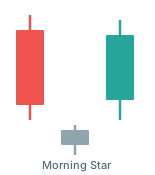
Appears: at the end of a decline
Signal: strong bullish reversal
Three parts:
- Large bearish candle, sellers in control
- Small candle of either colour below the first candle's close, the "star"
- Large bullish candle closing above the midpoint of the first candle's body
The morning star is one of the most respected bullish reversals in Nison's catalogue. The name is the planet Venus appearing before sunrise: the pattern signals daylight after the dark of a decline.
Act 1. A large bearish candle continues the decline with conviction.
Act 2. A small candle opens below the first candle's close and goes almost nowhere. The selling has stalled: sellers pushed price down at the open and could not sustain it. Any colour is acceptable; a doji star (the morning doji star) is the stronger version.
Act 3. A large bullish candle opens above the star and closes above the midpoint of the first candle's body. Buyers have taken control. The more of the first body the third candle recovers, the stronger the signal.
Ideal criteria:
- The star stands apart from the first candle's close and from the third candle's open.
- The third candle closes above the 50% level of the first candle's body.
- Volume on the third candle exceeds volume on the first.
Gaps in crypto. Crypto trades around the clock, so the visible gaps that the classical pattern describes rarely occur except around major events. In practice the star is a very small body clearly below the first candle's close, and the third candle opens above the star's close. The principle holds without a strict gap.
Evening Star

Appears: at the end of a rally
Signal: strong bearish reversal
Three parts:
- Large bullish candle, buyers in control
- Small candle above the first candle's close, the "star"
- Large bearish candle closing below the midpoint of the first candle's body
The bearish counterpart, with the same three acts in reverse. After a rally:
Act 1: a large bullish candle confirms buyer dominance. Act 2: a small star shows that buying has stalled at the high; the star is often a doji or a spinning top. Act 3: a large bearish candle closes below the midpoint of the first candle's body. Sellers have taken control.
In crypto scalping the evening star is most useful at all-time highs, previous resistance and round numbers where buyers are likely to be exhausted, and at the top of a sweep that has failed to hold.
Morning doji star and evening doji star. When the middle candle is a doji, the pattern carries more weight: the doji is complete indecision at the turning point, followed by resolution on the third candle.
Three White Soldiers

Signal: bullish continuation, or the start of a rally after a decline
Shape: three consecutive bullish candles, each opening within the prior candle's body and closing near its own high
Three white soldiers is a continuation pattern, or the opening phase of a new advance. Three successive bullish candles, each:
- opening within or above the previous candle's body,
- closing near its own high, with little or no upper wick,
- similar in size to the others.
Three periods of buyer dominance with no meaningful pushback from sellers. The pattern shows sustained conviction, not one period's result.
Ideal characteristics: similar body sizes (no dramatic acceleration, which can be exhaustion rather than continuation), closes near the highs, no large upper wicks.
The advance block. If the third soldier has a noticeably smaller body or a larger upper wick than the first two, buying momentum is fading. That variant is a warning that the rally may be stalling, and it is treated with caution rather than as a continuation signal.
Three Black Crows

Signal: bearish continuation, or the start of a decline after a rally
Shape: three consecutive bearish candles, each opening within the prior candle's body and closing near its own low
The mirror of three white soldiers. Three successive bearish candles, each opening within the prior body and closing near its own low: sellers dominant across three periods with no meaningful buyer response.
In crypto this pattern often accompanies structural breakdowns, when support fails and selling intensifies over several periods, and it is common in the first stage of a liquidation cascade.
Quality check: meaningful body sizes (small bodies are hesitation, not conviction), closes at or near the lows (long lower wicks weaken the pattern), each open inside the previous body.
Where three-candle patterns work best
At the extremes of extended moves. A morning star after a 10% three-day decline is far more significant than one after a 1% dip. Three white soldiers after a long consolidation signal a genuine breakout; after a parabolic rally, they can be the exhaustion that ends it.
At structural levels. A morning star at major support, an evening star at a previous high, three white soldiers through a multi-month resistance: the level amplifies the candle signal.
With volume confirmation. Rising volume on the directional candles (candles 1 and 3 in the stars, all three in the soldiers and crows) adds conviction. Volume fading on the star candle confirms that the pause is real.
With a stop beyond the pattern. The stop for a morning star long sits below the star's low; for an evening star short, above the star's high. That distance is the trade's 1R, and the risk management lesson sizes from it.
Comparison table
| Pattern | Type | Context | Key requirement |
|---|---|---|---|
| Morning star | Bullish reversal | End of a decline | Third candle recovers more than 50% of the first body |
| Morning doji star | Bullish reversal, stronger | End of a decline | Middle candle is a doji |
| Evening star | Bearish reversal | End of a rally | Third candle closes below 50% of the first body |
| Evening doji star | Bearish reversal, stronger | End of a rally | Middle candle is a doji |
| Three white soldiers | Bullish continuation | After a decline or a base | Three similar bullish bodies closing near their highs |
| Three black crows | Bearish continuation | After a rally | Three similar bearish bodies closing near their lows |
Where to go from here
You now have the pattern vocabulary. The next lesson is the one that makes it useful: the four layers of context that decide whether any pattern is a trade.
- Candlestick context and confirmation: trend, location, volume and order flow as the qualification.
Related guides:
- Two-candle patterns: engulfing, dark cloud cover, harami.
- Support and resistance: the levels where three-candle patterns carry most weight.
- Liquidations: the forced selling behind many three black crows.
- Crypto scalping strategies: the full strategies track.
- Glossary: support, resistance, liquidation cascade.
This article is educational content, not investment advice. Trading derivatives carries substantial risk, including total loss of capital. See disclaimer.